
A supplier can make a product look profitable on a spreadsheet and still leave you with late deliveries, inconsistent stock or expensive refunds. Finding a reliable dropshipping supplier is therefore not just a sourcing exercise: it is a decision about customer experience, cash flow and legal responsibility.
This 2027 guide explains where to search, how to verify potential partners and how to compare their true costs before committing advertising money. It uses a deliberately hypothetical example in pounds sterling. No supplier mentioned or category of platform is endorsed, and no scoring system can guarantee reliability.
What makes a dropshipping supplier reliable?
A reliable supplier is one whose identity, product quality, inventory, dispatch process, tracking, returns process and commercial terms you can check. The definition is operational rather than promotional. A polished website, low quoted price or collection of five-star reviews is not enough on its own.
Write down your requirements before approaching candidates: which countries you will sell into, the maximum delivery time you can honestly promise, acceptable defect rates, packaging standards, response-time expectations and the contribution margin needed to support advertising. Your supplier shortlist should be compared against the same requirements.
Where to find dropshipping suppliers
Supplier marketplaces and ecommerce integrations
Marketplaces and ecommerce apps can make product discovery, catalogue synchronisation and order routing more convenient. However, an integration does not establish that every seller on it is reliable. Review the actual trading entity, sample fulfilment, billing and support arrangements. Shopify describes supplier-marketplace apps, print-on-demand suppliers and independent supplier directories as distinct sourcing routes [1].
Wholesalers, manufacturers and authorised distributors
Contacting an established wholesaler or the manufacturer can produce clearer product specifications and supply arrangements. Some distributors require proof of trading status or minimum commitments. Ask whether they dispatch orders directly to your customers, whether neutral packaging is available and who handles faulty or undelivered goods.
Directories and trade contacts
Supplier directories may be useful for generating a shortlist. Some charge a subscription for access to their research or network. A directory fee is not automatically a scam, and a free listing is not automatically trustworthy. Treat all directory claims as leads to check independently, not proof of verification [1].
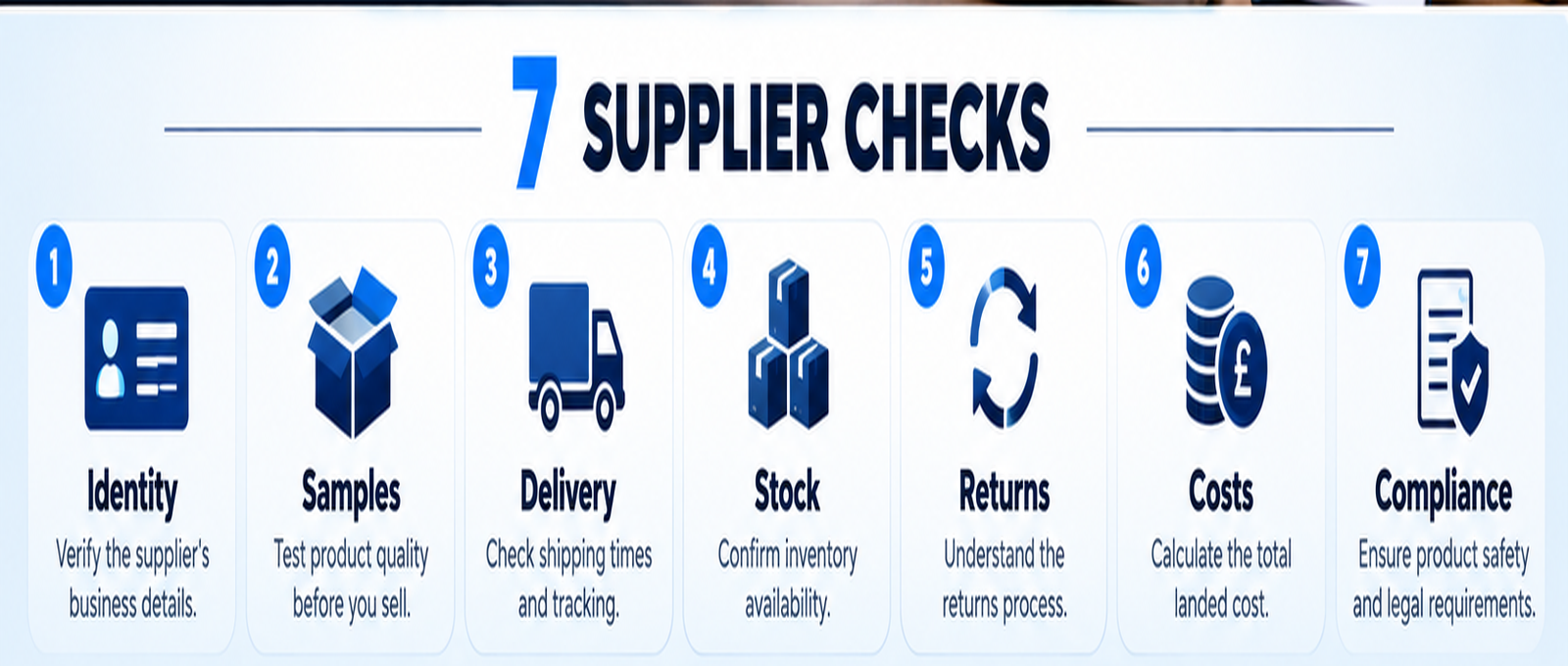
Seven checks to complete before selecting a supplier
1. Confirm business identity and contact details
Request the legal trading name, physical business contact details and an appropriate invoice. Check business-registration claims against an authoritative public register where one exists. Ask who is responsible for dispatch, after-sales issues and invoices. Unverifiable claims, inconsistent details or pressure to pay outside documented terms warrant caution.
2. Order a sample and inspect quality
Place a paid sample order using the same process an ordinary customer would experience. Assess the product against its advertised description, photographs, sizing and materials. Record the packaging, instructions, labelling, damage protection and tracking updates. Where relevant, repeat the test to detect inconsistency rather than judging an entire operation by one successful parcel.
3. Measure dispatch and delivery performance
Separate processing time, transit time and delivery time. A promise of three-day shipping is not a three-day customer delivery if dispatch takes another four days. Test the destination countries that matter to your shop, record actual timestamps and ask what happens when a parcel is delayed or lost. Include customs handling and duties where relevant.
4. Check inventory and order-handling processes
Ask how stock levels are updated, how often feeds refresh and whether the supplier reserves stock when an order is accepted. Confirm the process for out-of-stock items, partial fulfilment, substitutions and cancellations. Inventory errors become your customer-service problem even if the supplier caused them.
5. Get the returns and refund process in writing
Request the return destination, defect evidence requirements, restocking terms, refund timing and responsibility for shipping costs. In UK consumer sales, customer rights depend on the circumstances and applicable rules: GOV.UK explains distance-selling cancellation and refund obligations, as well as exceptions [2][3]. Do not treat a supplier’s restrictive internal policy as permission to disregard consumer rights.
6. Calculate the full cost per order
Obtain an itemised quotation showing the product, fulfilment and shipping charges, per-order fees, payment costs, taxes where relevant, and an evidence-based allowance for expected problems. Compare costs on a consistent basis. For example, do not compare a VAT-inclusive domestic quote against an overseas quote that excludes import charges without adjustment.
7. Check product safety and legal suitability
Identify applicable safety, labelling and sector-specific obligations before listing the item. UK government guidance states that businesses making, importing, distributing or selling consumer products have responsibilities for safety and appropriate labelling [4]. Product category and destination matter; a generic certificate image or the supplier’s assurance alone may be insufficient. Get qualified advice for complex or regulated categories.
The best supplier choice is not necessarily the one with the highest score. A failure in product safety, legal permissions or basic verifiability can be a reason to reject a candidate regardless of its price.
A practical seven-point supplier checklist
Use the following table during due diligence. “Evidence to keep” matters because memory and marketing promises are difficult to rely on during a dispute.
| Check | What to verify | Evidence to keep |
|---|---|---|
| Identity | Trading name, reachable contacts, invoices | Business-registration or trading evidence |
| Samples | Quality, packaging and description match | Order, photos, delivery log |
| Delivery | Dispatch lead time, tracking and transit | Sample timestamps and shipping terms |
| Stock | Refresh cadence and substitution policy | Written inventory workflow |
| Returns | Faults, return routing and reimbursements | Written return conditions |
| Costs | Product, freight, fees, problem allowance | Itemised quote and assumptions |
| Compliance | Safety and applicable labelling | Category-appropriate documentation |
UK suppliers versus international suppliers
A UK-based supplier may simplify domestic return routing, communication and delivery expectations, but local location alone does not guarantee good service or competitive unit economics. An international supplier may offer broader product ranges or lower factory prices, while introducing longer transit times, import charges, customs complexity or return friction. Neither route is universally better.
Compare delivery to your actual target customer, not merely shipping from the supplier’s warehouse. Verify where an item genuinely dispatches from; an advertised “UK warehouse” needs evidence. Google Merchant Center prohibits misleading statements about business or fulfilment location and hidden delivery or return conditions [5].
Worked example: a cheaper product can cost more
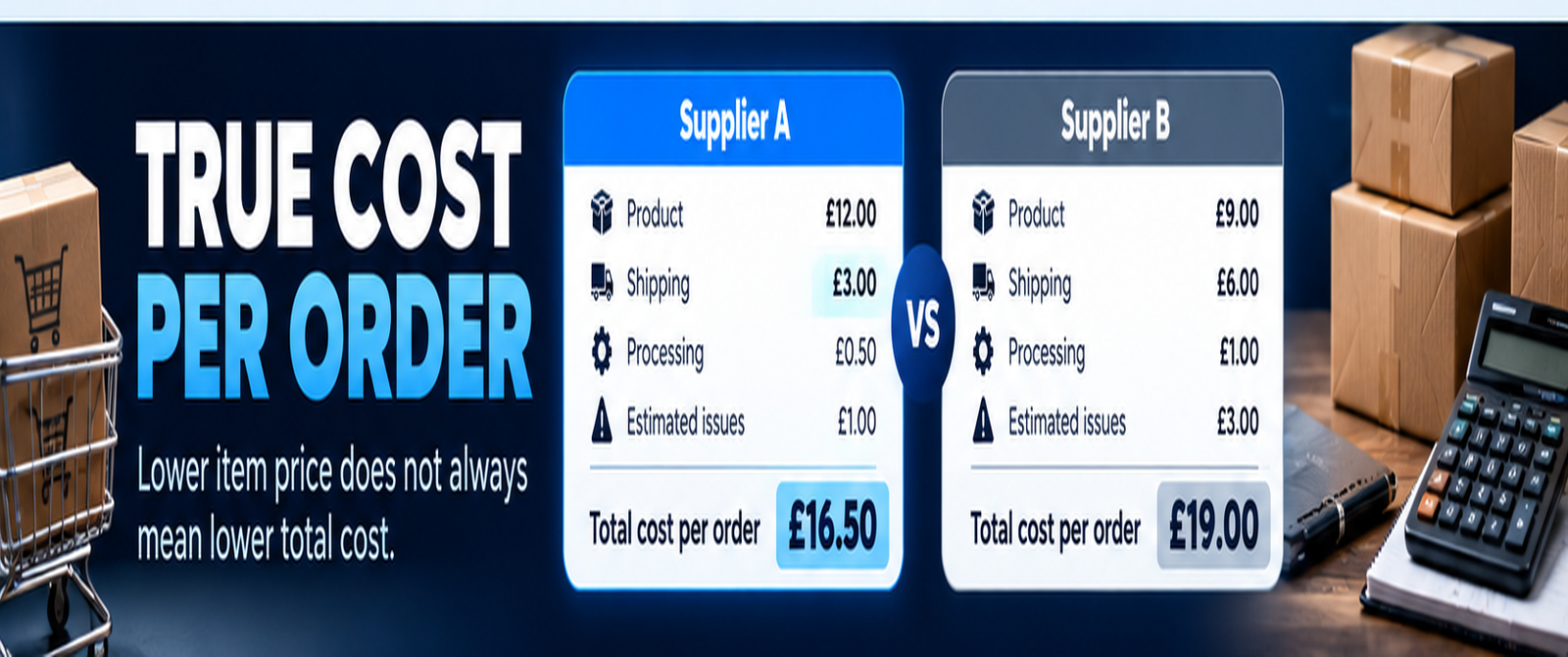
Consider two fictional suppliers quoting the same type of product for a UK-focused shop. These are planning assumptions, not live offers. The example excludes advertising, platform subscriptions, VAT treatment and any additional duties unless explicitly stated; those must be calculated separately for a real business.
| Cost per order | Supplier A | Supplier B |
|---|---|---|
| Product | £12.00 | £9.00 |
| Shipping | £3.00 | £6.00 |
| Processing fee | £0.50 | £1.00 |
| Estimated issues allowance | £1.00 | £3.00 |
| Modelled total per order | £16.50 | £19.00 |
Supplier A has the higher product price (£12 versus £9), but its modelled total is £16.50 per order versus £19.00 for Supplier B. Supplier B is £2.50 more expensive per order after shipping, processing and an estimated issue allowance. The allowance is a scenario assumption, not a measured defect rate. In practice, update it using your own claims and refund history.
At a hypothetical selling price of £35, these modelled amounts would leave £18.50 and £16.00 respectively before advertising, other operating expenses and relevant taxes. These figures are not net profit. Read our dropshipping profit margins guide and pricing guide before selecting a target price.
Supplier scorecard: compare evidence, not promises
For each of the seven checks, use 0 for no reliable evidence, 1 for partial evidence and 2 for satisfactory evidence. A theoretical maximum is 14 points. This simple checklist organises due diligence; it is not a scientifically validated supplier-risk model. Safety, compliance and business-identity concerns override any numerical total.
| Criterion | Example score |
|---|---|
| Business identity | 2/2 |
| Sample quality | 2/2 |
| Delivery evidence | 1/2 |
| Inventory evidence | 1/2 |
| Returns process | 1/2 |
| Full costs | 2/2 |
| Compliance documentation | 1/2 |
| Illustrative total | 10/14 |
Example: a fictional candidate scores 2 for identity, 2 for samples, 1 for delivery, 1 for inventory, 1 for returns, 2 for costs and 1 for compliance documentation. That is 10 out of 14, but unresolved compliance evidence still prevents approval. Gather missing documents and retest before proceeding.
Questions to ask a supplier before your first order
Ask for written answers, not simply a sales call summary. Useful questions include: What is the legal invoicing entity? Where does the product physically ship from? What is the normal processing time? How frequently does inventory update? Who pays for losses and faulty goods? Where do customers send returns? Can you provide sample tracking and product documentation? What happens during seasonal stockouts? Can you provide written rates for each destination?
Keep screenshots of quotations, invoices, sample tracking and agreed terms in a dated supplier folder. This creates an audit trail if the commercial relationship changes.
Red flags that should slow down your decision
Be cautious about unverifiable contact details, copied or contradictory product descriptions, refusal to provide sample evidence, unexplained price changes, promises of guaranteed sales, implausible delivery times, hidden return addresses and unsupported safety claims. One concern is not always definitive, but several unrelated concerns deserve investigation before spending money.
When should you use a backup supplier?
A second approved supplier can reduce dependence on one dispatch operation, but introducing a backup creates a new quality and documentation burden. Do not automatically switch live orders during shortages without checking product equivalence, customer disclosures, packaging and delivery dates. Verify the replacement candidate with the same seven checks.
How supplier selection fits the rest of your business
First use the product-validation guide to decide whether the product deserves further investigation. Then consult startup costs, break-even ROAS and the advertising-budget guide before paying for traffic. The Profit Calculator can help model costs; verify its currency input before using GBP examples.
Frequently asked questions
Are suppliers based in the UK always safer?
No. Location can affect transit times, communication and returns logistics, but a UK address does not replace a sample test, commercial verification or product-safety review.
Should I pay a supplier subscription before testing?
Understand exactly what the fee covers. A legitimate directory or service can charge for access, while a supplier may charge per-order fulfilment fees or impose minimums [1]. Compare the total commitment with the evidence available before paying.
Can I use two dropshipping suppliers for one shop?
Yes, operationally that may be possible. You must still manage product equivalence, stock, delivery promises, returns and order data accurately across both partners.
Who handles refunds when a dropshipped item is faulty?
The supplier relationship and consumer-facing seller responsibilities are different. Determine which entity is the retailer and what consumer law applies; your supplier’s private agreement does not automatically remove the customer’s statutory rights [2][3].
How do I know if a supplier is genuine?
Look for consistent business identity, an appropriate invoice, responsive support, working sample delivery, written commercial terms and evidence relevant to product compliance. No single sign provides certainty.
Final decision: investigate, pilot or reject
Choose “investigate” when key evidence is missing but there is a plausible way to obtain it. Choose a limited pilot only when core identity, sample quality, delivery, economics and compliance checks are satisfactory. Reject a supplier when critical evidence cannot be obtained or risks cannot be acceptably controlled. The objective is not to find the cheapest catalogue; it is to support a customer promise you can deliver.