
If you buy a dropshipping product for £12 and charge £24, you have doubled the supplier’s product cost. That does not mean you have made a 50% net profit margin. Supplier delivery, payment processing, advertising and returns can absorb much of the difference.
The safer question is: what selling price would cover a clearly defined set of costs and leave the profit margin you want? This guide walks through that question using a reusable pricing formula and a worked example in pounds sterling. It also explains why a mathematically viable price may still be too high for customers.
Important: All numbers below are illustrations, not current supplier quotes, typical advertising costs or forecasts for 2027. Calculations use a VAT-exclusive basis unless stated otherwise. Pricing, tax and consumer-law decisions depend on your circumstances; this article is educational, not accounting, tax or legal advice.
Start with the full cost of fulfilling an order
The supplier’s product price is only the starting point. Record the actual cost of the product, supplier shipping, packaging or fulfilment, payment charges, any marketplace commission, and the advertising expenditure you expect per order. Include an evidence-based allowance for the net loss from returns or refunds if it is not already accounted for elsewhere.
Separate three kinds of input:
- Fixed amount per order: for example £15 for the product and supplier delivery, £8 in advertising, £1 in expected refund-related losses, and a £0.30 flat payment charge.
- Percentage of selling price: a payment-processing or marketplace fee charged as a percentage of the amount collected.
- Desired profit margin: the portion of the defined selling-price basis you want to retain after the costs included in this model.
A fourth group—monthly software subscriptions, support and other fixed overhead—can be allocated across expected orders for planning. That allocation is an assumption, not an automatic supplier cost. Write down the expected sales volume used to calculate it. If you omit overhead, do not describe your result as a complete business-wide net margin.
Be careful about refunds: if revenue is already adjusted for refunds, do not subtract the same expected lost revenue again. A refund allowance must say whether it covers retained supplier charges, return transport, unrecovered payment fees or another defined loss.
For background on start-up and operating expenses, see How Much Does It Cost to Start Dropshipping?.
Markup vs profit margin: they are not interchangeable
Markup compares profit with cost. Margin compares the same profit with the selling price. Shopify’s explanation uses these different denominators, which is why the two percentages should not be confused.1
Markup (%) = (selling price − cost) ÷ cost × 100
Margin (%) = (selling price − cost) ÷ selling price × 100
Suppose a product costs £20 and sells for £30. The £10 difference is 50% of cost, so the markup is 50%. It is only 33.3% of the £30 selling price, so the margin is 33.3%. These are gross illustrations using only the £20 cost: neither percentage includes advertising or processing fees.
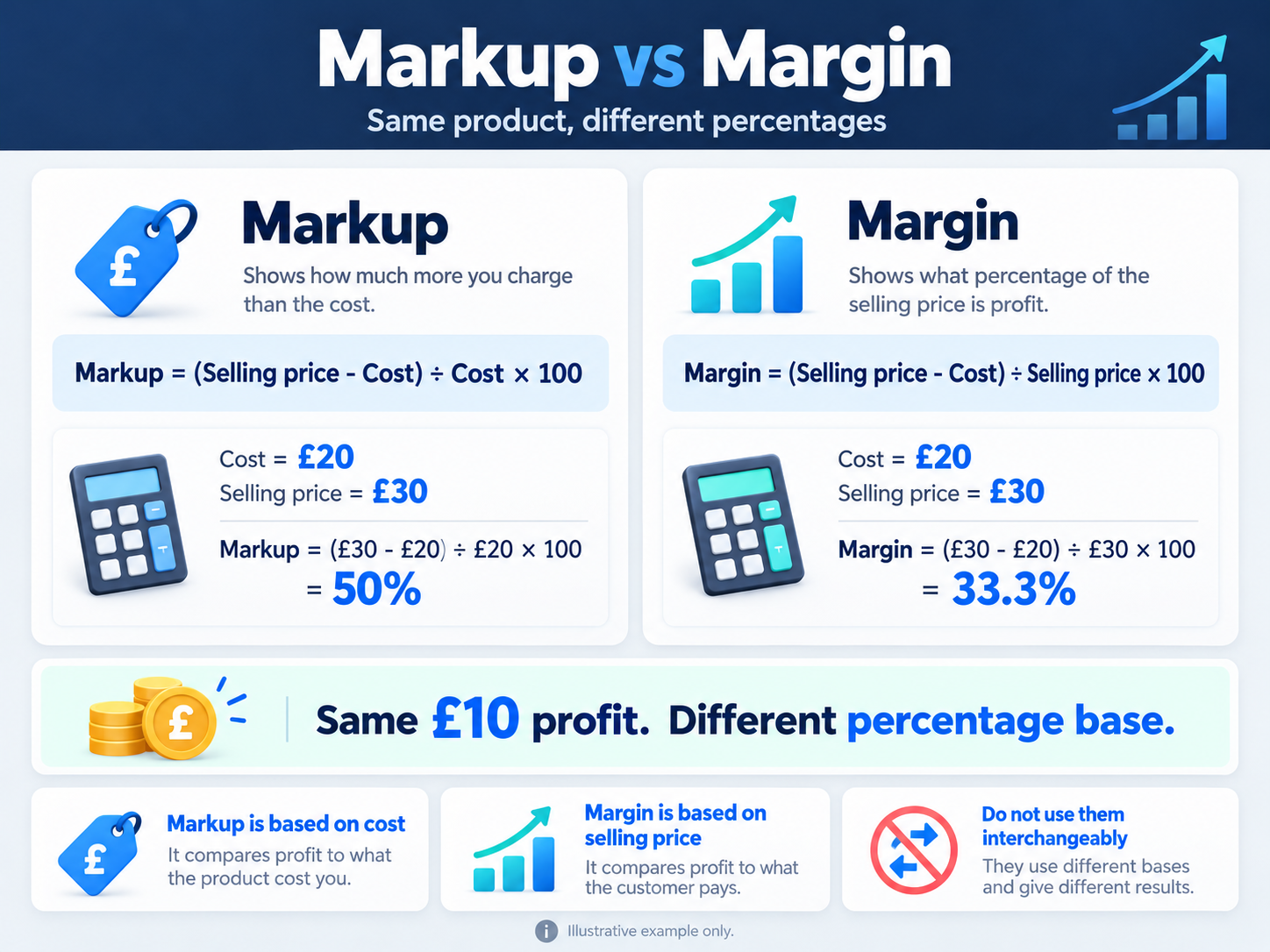
This distinction matters because entering a desired 20% margin as though it were a 20% markup understates the required price. For a comprehensive discussion of margins across orders, refer to Dropshipping Profit Margins Explained.
The dropshipping pricing formula
For a simple one-order model, let:
- P = VAT-exclusive selling price per order;
- C = fixed pound costs included per order before the flat processing charge;
- F = flat transaction charge per order;
- r = total percentage-based fees expressed as a decimal; and
- m = desired profit margin after all costs included in this model, expressed as a decimal.
The modelled profit is P − rP − C − F. To earn a margin of m on selling price, set that profit equal to mP and rearrange:
Minimum selling price: P = (C + F) ÷ (1 − r − m)
The denominator must be greater than zero. If the percentage fees plus desired margin reach or exceed 100%, there is no finite positive price that satisfies this simplified model. This formula also assumes the percentage fee applies to the same revenue basis as P. If a provider charges on a VAT-inclusive amount while your calculation uses VAT-exclusive revenue, the fee basis must be adjusted before using the formula.
A worked £31.56 example
Imagine one order with the following illustrative, VAT-exclusive assumptions. The advertising cost is an assumed acquisition cost for one attributed order, not a prediction of what a campaign will achieve.
| Input | Assumed value | What it represents |
|---|---|---|
| Supplier product and delivery | £15.00 | Product plus supplier fulfilment |
| Advertising per order | £8.00 | Assumed paid acquisition cost |
| Refund/returns loss allowance | £1.00 | Defined planning loss allowance |
| Flat processing charge | £0.30 | Assumed fixed fee |
| Percentage processing charge | 3% | Illustrative percentage of selling price |
| Target margin after listed costs | 20% | Illustrative operating target |
The fixed costs before the flat payment charge total C = £15 + £8 + £1 = £24. The flat charge is F = £0.30, the percentage rate is r = 0.03, and the target is m = 0.20.
P = (£24 + £0.30) ÷ (1 − 0.03 − 0.20) = £24.30 ÷ 0.77 = £31.55844…
Rounded up to the nearest penny, the minimum price under these assumptions is £31.56. At that price, a 3% fee is approximately £0.9468 and modelled profit after the listed costs is £6.3132, approximately 20.0038% of revenue. Penny-level payment-fee rounding can affect the last fraction of a penny. Treat this as a planning calculation, not an actual processor settlement.
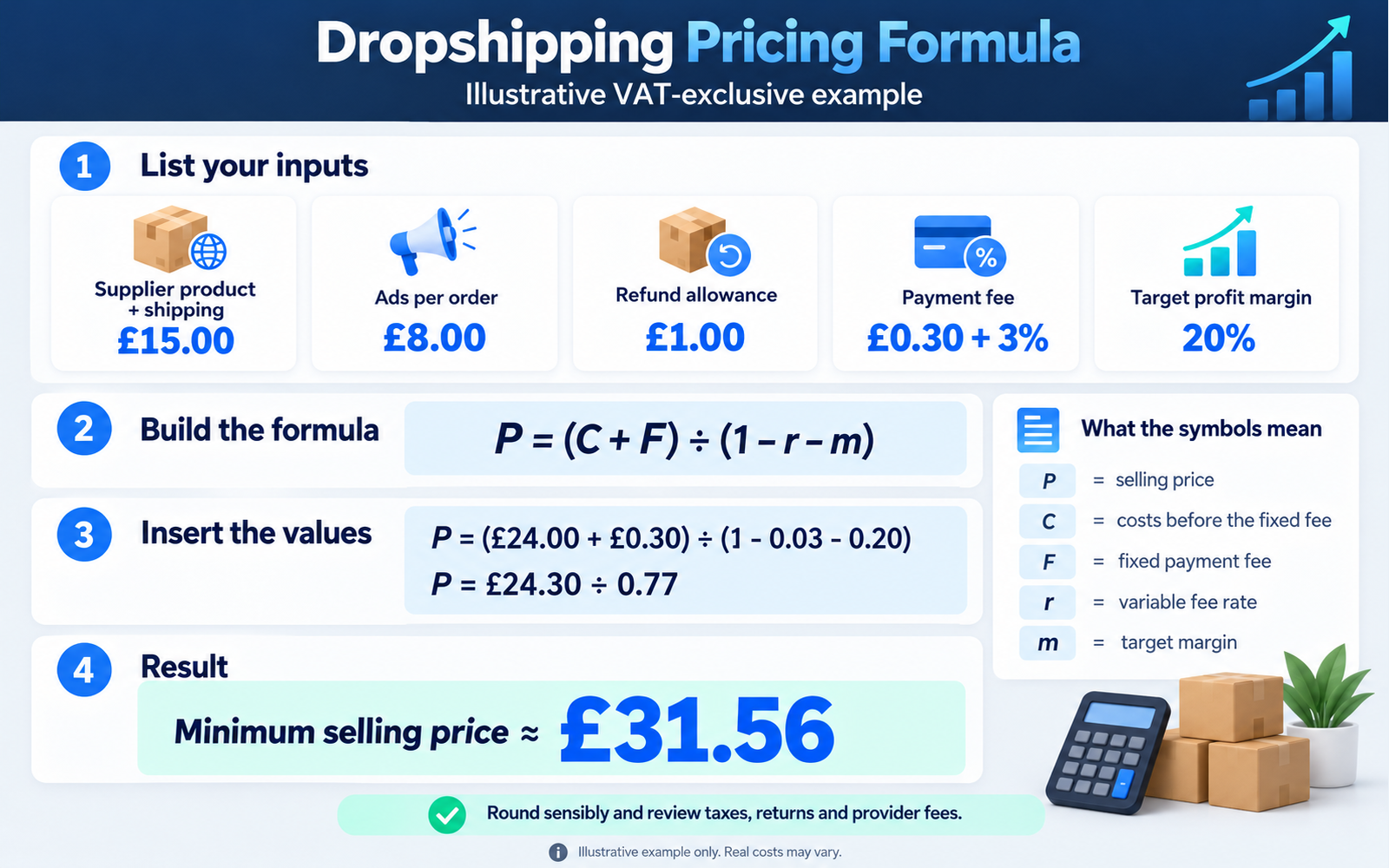
Notice that £31.56 is the required VAT-exclusive model price, not automatically the consumer-facing checkout price in the UK. VAT treatment and unavoidable delivery or transaction charges must be accounted for when showing prices to consumers.3
How advertising cost changes your minimum price
Keeping all other inputs fixed, increasing the assumed cost per order increases the selling price necessary to preserve the same 20% modelled margin.
| Assumed advertising cost per order | Calculated minimum price (rounded up) |
|---|---|
| £5.00 | £27.67 |
| £8.00 | £31.56 |
| £12.00 | £36.76 |
These values are sensitivity tests, not recommended advertising budgets or selling prices. They assume one tracked order per acquisition and a constant fee rate. Real ad costs change with channel, targeting, creative quality, returns and attribution. If advertising becomes too expensive, reconsider the offer and acquisition strategy rather than assuming customers will accept any price you calculate.
Break-even price vs a profit-target price
A break-even selling price within this same model sets m = 0. With C = £24, F = £0.30 and r = 3%:
Break-even P = £24.30 ÷ 0.97 = £25.0515…, or £25.06 rounded up to the next penny.
With a 20% margin target, the model requires £31.56. Both prices depend on the same included costs. Neither guarantees business-wide profitability, and a £25.06 break-even price leaves essentially no modelled cushion for uncertainty.
Once you have a selling price, you can work in the other direction: calculate your allowable advertising cost and compare it with actual CPA and ROAS. Our break-even ROAS guide explains why an apparently strong ROAS may still fail to cover an order’s economics.
VAT and transparent pricing for UK customers
VAT-exclusive calculations can be useful for planning when the tax basis is consistent, but they are not necessarily the prices customers should see. VAT registration, recoverable input VAT, import arrangements and customer location can change the correct treatment. Seek advice for your supply chain rather than applying one simplified rule to every UK dropshipping business.
The Competition and Markets Authority’s UK price-transparency guidance says consumers should generally see the total price with mandatory charges, including applicable taxes and unavoidable delivery fees, presented clearly up front. Avoid a low headline price that becomes substantially more expensive only during checkout.3
If you advertise through Google Merchant Center, the submitted product price must meet the platform’s matching requirements for the landing page and checkout, including currency and country-specific rules.4 Check current rules for your target market when you launch, rather than assuming a 2026 policy will remain unchanged during 2027.
Test whether the price makes commercial sense
A mathematically correct price is only one side of a pricing decision. Before listing the product, check directly comparable offers, shipping times, warranty and returns terms, product quality, support expectations and trust signals. A cheaper competitor may sell a different specification or offer slower delivery; a more expensive competitor may have stronger evidence and service.
Ask whether the customer can understand why your offer is worth the total price. If customers will not pay enough to cover your costs, do not manufacture profitability by hiding charges or treating projected revenue as profit. Improve supplier economics, offer value, reduce waste, or select a different product.
Never interpret a 2x or 3x product-cost multiple as proof of a profitable business. It ignores the actual acquisition and order-level economics.
Use the DropToolKit Profit Calculator carefully
The free DropToolKit Profit Calculator can help evaluate a chosen selling price. Its visible inputs include selling price, units per order, product and shipping costs, percentage platform fees, flat transaction fee, advertising spend per order and tool cost per order. The results include net profit per order, profit margin, total costs and break-even CPA.5
The calculator’s input amounts are in USD and it presents an approximate GBP view using a conversion-rate input. Therefore do not paste the £31.56 number into the USD selling-price field as if the currencies were equivalent. Convert the entire illustrative scenario consistently using a documented rate, or use a separate example entirely in USD.
The tool does not have a dedicated target-margin reverse-pricing input or an explicit returns-loss field. Calculate the proposed minimum price manually first; then use the calculator to stress-test an appropriately converted input set. If you include a refund allowance or overhead within another input, keep a written note of that adjustment and do not count it twice.
Five-minute pricing checklist
- Collect supplier invoices, shipping costs, provider fees and any unavoidable per-order charges.
- Choose one currency and one tax basis for the model.
- Estimate advertising cost per attributable order and document how it was derived.
- Define any refund-loss allowance and overhead allocation without double counting.
- Apply P = (C + F) ÷ (1 − r − m), round up to an appropriate selling-price unit, then test competitors and the total consumer-facing checkout price.
Recalculate whenever supplier prices, shipping, ad performance, refunds, fees or tax treatment change. A 2027 planning guide cannot predict those inputs for you.
Common pricing mistakes
Treating markup as net margin
A 50% markup on cost does not mean a 50% margin. Always name both the denominator and the costs included.
Forgetting that some fees rise with price
For percentage-based fees, simply adding a fixed amount to cost can understate the price required to preserve a target margin. Use the percentage term in the denominator, while checking the provider’s real fee basis.
Pricing in a different currency from the cost model
An approximate GBP display of USD calculator results is not a substitute for consistent exchange-rate assumptions, payout charges and timing. Keep transaction currency and conversion effects transparent.
Treating refunds as a universal flat rate
A loss allowance should reflect your own returns experience or be clearly marked as an assumption. Do not subtract refunded revenue and the same refund loss twice.
Ignoring the customer’s final checkout total
A plausible VAT-exclusive planning result can still produce misleading consumer pricing if unavoidable taxes or charges are added late. Display prices in line with the applicable rules.3
Frequently asked questions
How do I calculate a dropshipping selling price?
Add up the relevant fixed per-order costs, include any flat processing fee, then divide by one minus the percentage-based fees and desired margin (both decimals). The formula only covers costs explicitly included and assumes consistent bases.
Is a 2x markup enough for dropshipping?
Not necessarily. It depends on product and shipping cost, payment fees, advertising per order, refunds, overhead and your target. There is no safe universal multiplier.
What is the difference between a 20% markup and a 20% margin?
A 20% markup adds one-fifth of cost. A 20% margin means the defined profit is one-fifth of the selling price. If the only cost is £20, a 20% markup gives £24; a 20% margin requires £25.
Should I include advertising in product pricing?
For a profitability model, yes, if advertising is part of acquiring those orders. Use an appropriately defined expected cost per order, and compare your assumptions with realised results.
Should I use VAT-inclusive or VAT-exclusive prices?
Use a consistent basis for internal calculations that matches your tax circumstances. The customer-facing price must comply with the requirements for your market, including mandatory charges. Consult appropriate guidance for your business.
Does the DropToolKit Profit Calculator find my ideal selling price?
It analyses a selling price and cost inputs; it does not have a dedicated reverse calculation for a specified target margin. Calculate the candidate price first, then use the calculator for scenario analysis with consistent currency inputs.
Conclusion
Product pricing is not just a markup decision. Start with the real costs of one order, identify percentage fees and decide what margin your model needs to retain. The formula then gives a transparent mathematical threshold—but your customer, your market and your legal obligations determine whether that price is practical.
In the illustrated case, £31.56 is enough to meet the stated 20% margin target after only the listed modelled costs. It is not a universal dropshipping price, a forecast for 2027 or a guarantee of profit. Revisit the model as real data replaces assumptions.
Source notes
- Shopify — Markup vs. Margin: Key Differences + How to Calculate, reviewed 23 October 2026.
- Stripe — Pricing and fees for UK businesses, for provider-specific fees and the need to verify current payment terms; reviewed 23 October 2026.
- UK Competition and Markets Authority — Providing clear and accurate information about prices, updated 7 January 2026; reviewed 23 October 2026.
- Google Merchant Center Help — Price attribute requirements, reviewed 23 October 2026.
- DropToolKit — Profit Calculator, interface reviewed 23 October 2026.