
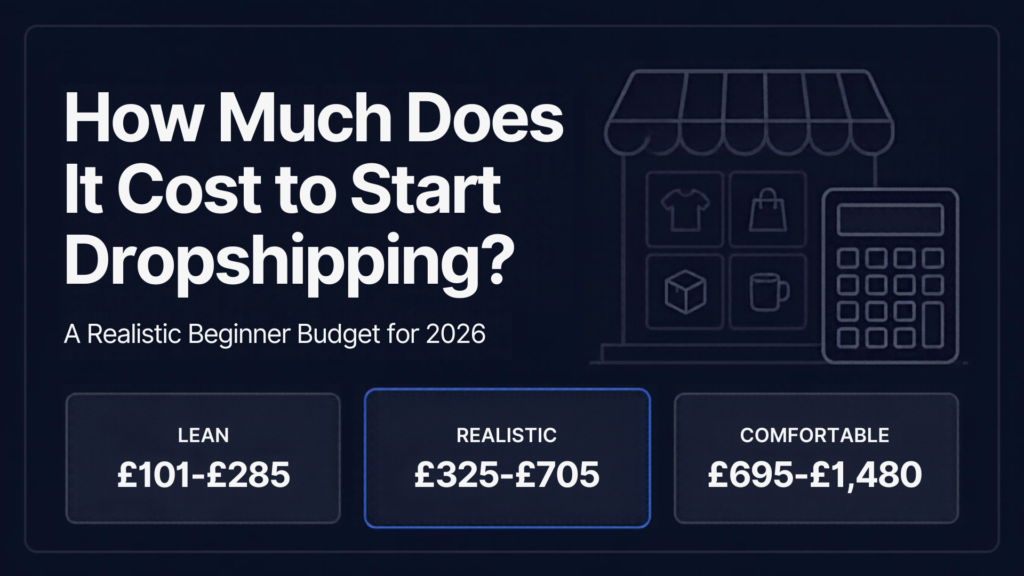
You can launch a basic dropshipping store for relatively little money. Properly testing whether that store can attract customers, handle orders, survive refunds, and produce a profit usually costs more.
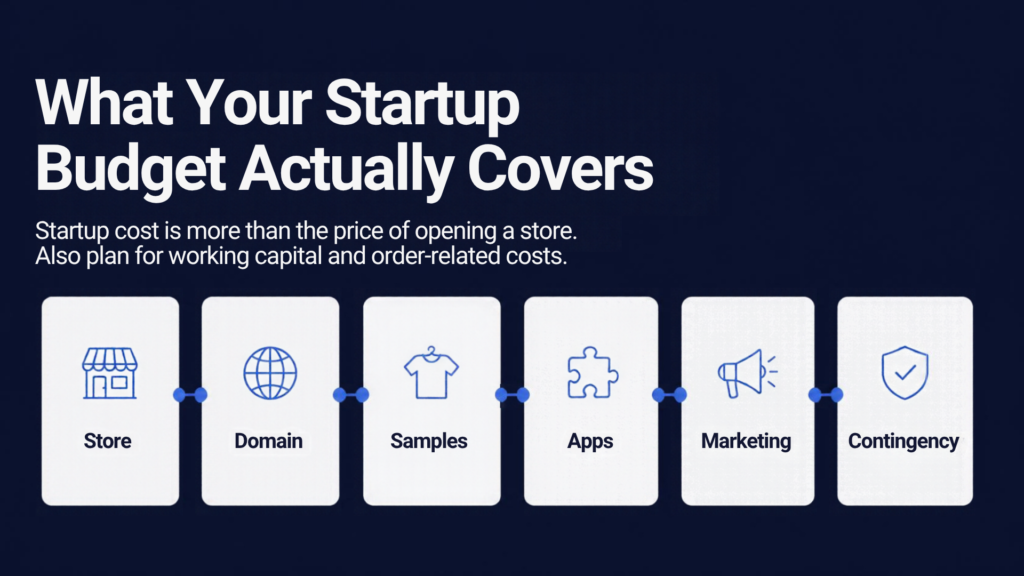
That is why a useful startup budget should include more than the website itself.
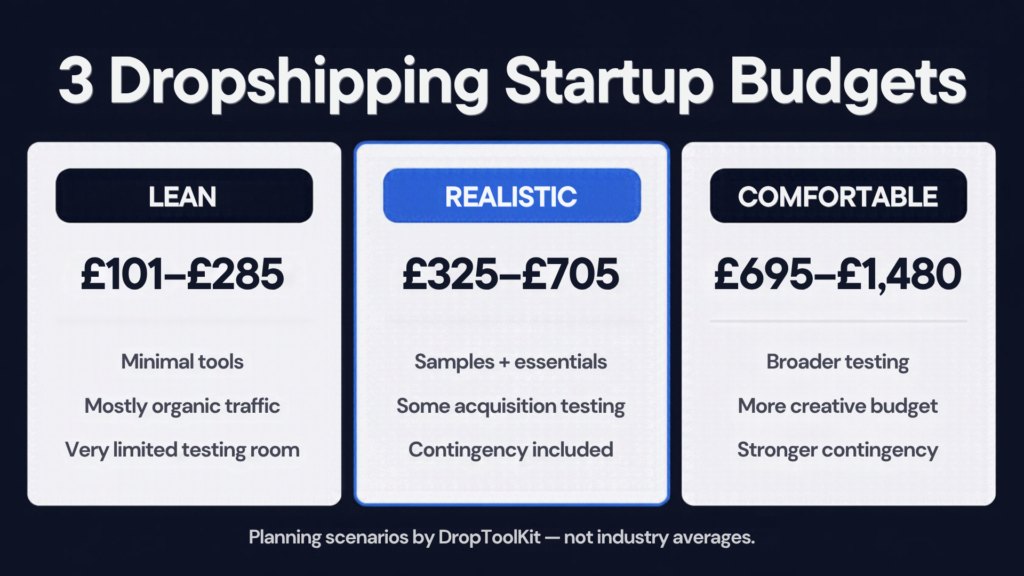
For planning purposes, DropToolKit uses three broad scenarios:
- Lean Validation Budget: about £101–£285
- Realistic Beginner Budget: about £325–£705
- Comfortable Testing Budget: about £695–£1,480
These are DropToolKit planning scenarios, not official industry averages. They are designed to help you estimate the cost of testing a business, not to promise that a certain amount will be enough for every store.
The most important distinction is simple:
The cost of opening a store is not the same as the cost of validating a dropshipping business.
Quick Answer: What Budget Should a Beginner Expect?
Lean Validation Budget — £101–£285
Best for:
A beginner trying to validate an idea with minimal fixed costs, limited product samples, a small software stack, and mostly organic traffic.
Main limitation:
Very little room for failed paid-ad tests, extra samples, refunds, or unexpected costs.
Realistic Beginner Budget — £325–£705
Best for:
A beginner who wants a credible store, some product validation, essential tools, a modest customer-acquisition budget, and a contingency reserve.
Why this is the most useful reference:
It gives you room to test without assuming that everything must be premium from day one.
Comfortable Testing Budget — £695–£1,480
Best for:
A beginner who wants more room for samples, creative testing, paid traffic, software, and operational mistakes.
Main limitation:
A larger budget does not guarantee demand, profitable ads, or a reliable supplier.
Budget Comparison
| Scenario | Approximate Range | Best Fit | Main Trade-off |
|---|---|---|---|
| Lean Validation | £101–£285 | organic-first launch with minimal software | very little room for testing errors |
| Realistic Beginner | £325–£705 | balanced launch with some paid testing | still requires tight cost control |
| Comfortable Testing | £695–£1,480 | broader testing and stronger contingency | easier to overspend before validation |
For most beginners, the middle scenario is the most useful planning reference.
Why Dropshipping Startup Costs Vary So Much
Online estimates vary because they often measure different things.
A very low estimate may include only:
- an introductory ecommerce-platform offer
- a domain
- a free theme
- free apps
- organic social media
A larger estimate may include:
- product samples
- paid tools
- paid advertising
- creative production
- business setup
- payment fees
- refunds and returns
- contingency
- working capital
Those are not the same launch.
A storefront can be cheap. A responsible business test usually needs more than a storefront.
The 5 Types of Costs You Need to Separate
1. Startup Costs
These are the initial costs required to get the business ready to operate.
Examples include:
- domain registration
- initial product samples
- store setup
- basic branding
- first creative assets
- registration or compliance costs where applicable
Some are one-time costs. Others become recurring later.
2. Recurring Operating Costs
These continue after launch.
Examples include:
- ecommerce platform subscription
- paid apps
- email software
- analytics tools
- supplier-platform subscriptions
- accounting software
A business that costs £50 to launch can still become expensive if it accumulates unnecessary monthly subscriptions.
3. Variable Costs
These rise or fall with sales and activity.
Examples include:
- supplier product cost
- fulfilment fees
- shipping
- payment-processing fees
- transaction fees
- refunds
- returns
- chargebacks
These affect the economics of each order, so they should not be hidden inside a generic startup-cost figure.
4. Testing Capital
Testing capital is money deliberately reserved to learn what works.
It may cover:
- paid advertising
- multiple creatives
- product samples
- landing-page tests
- audience tests
- offer tests
You can build a store without much testing capital. That does not mean you have properly tested the business.
5. Working Capital
Working capital is the cash available to keep the operation moving.
You may need it for:
- supplier charges
- refunds
- replacement orders
- chargebacks
- payment holds
- shipping problems
This matters because customer payments and supplier payments may not line up perfectly.
Having enough money to build the site is not always the same as having enough cash to operate the business.
Ecommerce Platform Costs
Your platform is usually one of the first recurring expenses.
As of October 2026, Shopify UK shows its Basic plan from £19 per month when billed yearly. Shopify is also currently promoting a three-day free trial followed by three months at £1 per month.
That introductory price can make the first few months look extremely cheap, but it should not be treated as the normal long-term cost.
Shopify is only one option. Alternatives include:
- WooCommerce
- other hosted ecommerce platforms
- marketplaces
- custom ecommerce setups
A hosted platform may give you simpler setup and predictable subscription pricing.
A self-hosted setup can shift costs into hosting, security, maintenance, plugins, and technical support.
The cheapest advertised platform is therefore not necessarily the cheapest system to operate.
Always check the provider’s current official pricing page before buying. Promotions, billing terms, taxes, and regional prices change.
Domain and Store Setup
A normal domain is usually a small part of the total budget, but first-year pricing can be misleading.
Check:
- first-year price
- renewal price
- extension
- whether the domain is premium
- whether privacy or other add-ons cost extra
You also do not need an expensive visual setup to validate a business.
A credible launch can often use:
- a free theme
- a simple logo
- consistent colours
- clear product imagery
- clean product pages
- basic trust information
Premium themes, custom development, and expensive branding can wait until the business shows evidence that more investment is justified.
Product Samples
Samples are easy to exclude from a low-cost startup estimate, but they can reduce risk.
When practical, samples let you check:
- product quality
- packaging
- shipping speed
- delivery experience
- instructions
- likely customer complaints
- whether the item works well for your own photos or videos
That makes samples a validation expense, not just a cosmetic one.
Printful is a useful example of a fulfilment model where account access itself does not require a monthly fee. Its official pricing page says there are no upfront costs to start selling and no monthly fee to create products or connect a store; fulfilment is paid when a customer orders.
The broader lesson is more important than the example:
“Free to connect” does not mean “free to fulfil.”
Product, fulfilment, shipping, tax, and other order-related costs can still apply.
Dropshipping Apps and Tools
Apps are useful when they solve a real problem. They become expensive when they are installed because they might be useful later.
Common categories include:
- supplier/import tools
- product-research tools
- review apps
- email tools
- analytics
- upsell tools
- currency tools
- automation
- creative software
What You Actually Need at Launch
Start with the smallest stack that lets you:
- list products
- process orders
- communicate with customers
- measure basic performance
Add more software only when you can explain the problem it solves.
Where Beginners Overspend on Apps
Common examples include:
- paying for several product-research tools at once
- installing multiple upsell apps
- paying for advanced email automation before building a list
- buying premium analytics before having meaningful traffic
- paying for automation before there is repetitive work to automate
A £10 subscription feels small.
Ten unnecessary £10 subscriptions create £100 of recurring monthly overhead.
Marketing and Advertising
Marketing is often the largest variable in the entire startup budget.
Two stores can have nearly identical setup costs and completely different customer-acquisition costs.
Organic-First Approach
An organic strategy can use:
- TikTok
- YouTube Shorts
- SEO
- blog content
- creator-style product content
The cash cost can be low, but the time cost is not.
You still need to create content, test angles, learn what earns attention, and publish consistently.
Organic traffic is not free. It trades cash spending for time and execution.
Paid Testing Approach
Paid advertising can produce faster feedback, but it requires testing capital.
Possible channels include:
- Meta Ads
- Google Ads
- TikTok Ads
- other paid social or search channels
There is no honest universal answer to “How much should I spend on ads?”
The amount required depends on:
- product price
- gross margin
- creative quality
- conversion rate
- target market
- advertising channel
- offer
- competition
The right planning principle is not “spend X per day.”
It is:
Reserve enough money to run useful tests, expect that some tests will fail, and do not spend money you cannot afford to lose.
Branding and Creative Costs
Professional does not have to mean expensive.
At launch, professional usually means:
- consistent
- readable
- credible
- clear
- trustworthy
It does not automatically require:
- agency branding
- expensive logo packages
- a premium theme
- extensive custom development
Creative spend becomes more important if you use paid advertising because you may need multiple images, videos, hooks, and demonstrations.
But creative costs should grow with evidence, not ahead of it.
Business, Tax and Compliance Costs
This category cannot be reduced to one universal figure.
Requirements depend on factors such as:
- where you live
- where the business is established
- where customers are located
- where goods are located when sold
- whether you sell directly or through a marketplace
- VAT or sales-tax rules
- product category
- business structure
For UK readers, current HMRC guidance still uses a £135 consignment threshold in several rules for low-value goods sold into the UK. However, the UK government also published a July 2026 policy paper announcing reforms to the customs treatment of low-value imports.
That is a useful reminder that tax and customs rules can change faster than evergreen business articles.
Do not use one fixed tax or registration figure for every beginner.
Instead, include a compliance allowance when relevant and verify your exact obligations using current official government guidance or a qualified professional.
This article is not tax or legal advice.
Hidden Cost: Cash Flow, Refunds and Supplier Timing
A customer payment is not automatically available profit.
A simplified order can look like this:
1. A customer buys.
2. Your supplier requires payment.
3. The order is fulfilled.
4. Your payment provider releases funds according to its own timing.
5. The customer may later request a refund or dispute the charge.
The exact timing depends on the providers involved.
That means a business can look profitable on paper and still experience cash-flow pressure.
A contingency reserve can help cover:
- supplier payments
- refunds
- replacement orders
- shipping problems
- processing delays
- chargebacks
Do not spend every pound of your startup budget on the storefront.
Three Example Dropshipping Budgets
These are planning models, not guarantees.
Scenario 1: Lean Validation Budget — £101–£285
Possible allocation:
Store/platform: £1–£25
Domain: £10–£20
Samples: £20–£50
Apps/tools: £0–£20
Branding/creative: £0–£20
Marketing/testing: £50–£100
Contingency: £20–£50
Best for:
A cost-conscious beginner using minimal software and relying heavily on organic acquisition.
What it does well:
It lets you begin validating an idea without large fixed commitments.
What it does poorly:
It gives you limited room for failed paid tests, additional samples, or operational surprises.
Scenario 2: Realistic Beginner Budget — £325–£705
Possible allocation:
Store/platform: £25–£50
Domain: £10–£20
Samples: £50–£100
Apps/tools: £20–£60
Branding/creative: £20–£75
Marketing/testing: £150–£300
Contingency: £50–£100
Best for:
A beginner who wants a balanced, disciplined test.
Why DropToolKit uses this as the main reference:
It gives you room for samples, essential tools, creative work, acquisition testing, and a contingency reserve without assuming a premium setup.
Scenario 3: Comfortable Testing Budget — £695–£1,480
Possible allocation:
Store/platform: £50–£100
Domain: £10–£30
Samples: £100–£200
Apps/tools: £60–£150
Branding/creative: £75–£200
Marketing/testing: £300–£600
Contingency: £100–£200
Best for:
A beginner who wants more room for experimentation.
What the extra money buys:
More samples, more creative tests, a larger acquisition budget, and more contingency.
What it does not buy:
Guaranteed demand, profitable ads, reliable suppliers, or a winning product.
Where Beginners Usually Overspend
Premium Themes Too Early
A premium theme cannot fix a weak product, poor offer, or bad unit economics.
Too Many Apps
Every recurring subscription raises your break-even point.
Expensive Branding Packages
Branding matters, but heavy spending before validation can be premature.
Courses and Overlapping Tools
Education can help, but several courses and subscriptions can consume money that would be more useful in actual market testing.
Automation Before Volume
Automation is valuable when repetitive work exists.
Automating a store with no traffic or orders does not create demand.
Paid Traffic Before Understanding Unit Economics
Before scaling ads, understand:
- selling price
- product cost
- shipping
- payment fees
- expected refunds
- gross margin
- acceptable acquisition cost
Otherwise, more traffic can simply accelerate losses.
Where Cutting Costs Can Backfire
Being frugal is useful only when it does not create avoidable risk.
Cutting the wrong costs can hurt you.
Examples include:
- never ordering a sample
- choosing an unreliable supplier only because it is cheaper
- ignoring refunds and returns
- launching a store with weak trust signals
- keeping no contingency
- spending nothing on validation
- choosing every tool only because it is free
A better question is not:
“What is the cheapest way to start?”
It is:
“What is the cheapest way to test this idea responsibly?”
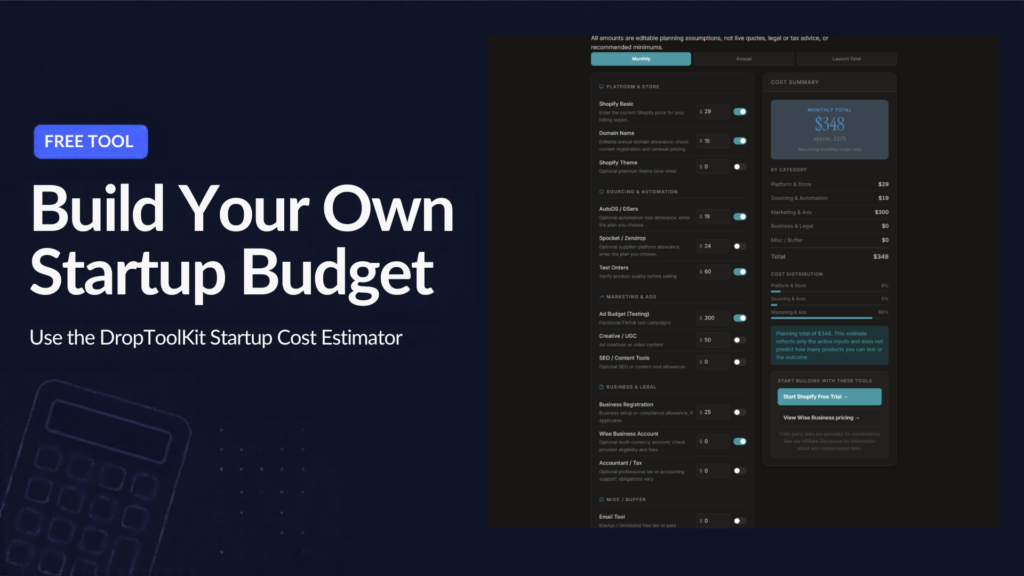
How to Calculate Your Own Startup Budget
Your real budget depends on your actual choices.
Start with these categories:
1. Store/platform
2. Domain
3. Product samples
4. Essential apps
5. Branding/creative
6. Marketing/testing
7. Contingency
Then ask two more questions:
- How much working capital might I need after the first order?
- Which costs repeat every month?
The DropToolKit Startup Cost Estimator is designed to help you build this kind of personalized estimate before you spend money.
Use it as a planning tool, not as a promise of success.
A Simple Beginner Rule for Budgeting
A practical mental model is:
1. Fund the store.
2. Fund product validation.
3. Fund customer acquisition.
4. Keep a contingency reserve.
5. Keep personal living money separate from business testing money.
Do not fund a speculative business test with money you need for rent, food, utilities, debt payments, or other essential obligations.
Frequently Asked Questions
Can You Start Dropshipping With £100?
Possibly, in a very constrained setup.
Promotional platform pricing, free tools, and organic traffic can reduce the initial cash requirement.
But £100 leaves little room for samples, paid testing, refunds, or unexpected costs. Treat it as a lean validation budget, not a universal recommendation.
How Much Should a Beginner Spend on Ads?
There is no universal amount.
Your useful testing budget depends on the advertising channel, product economics, margin, creative quality, target market, and testing strategy.
The goal is not to hit a magic number. It is to run tests that are large enough to teach you something without risking money you cannot afford to lose.
Do You Need to Buy Inventory Upfront?
Usually not in bulk under the traditional dropshipping model.
However, you may still need cash for samples, supplier payments, refunds, replacement orders, and payment-timing gaps.
Is Shopify Required for Dropshipping?
No.
Shopify is one popular option, but other ecommerce platforms and marketplaces can support dropshipping.
Choose based on cost, technical ability, integrations, payment options, and the type of store you want to build.
Are Paid Apps Necessary?
Not always.
Start with essential functionality. Add paid software only when it solves a real operational problem or produces enough value to justify the recurring cost.
What Is the Biggest Hidden Cost?
For many beginners, it is not the website.
The larger risks are often:
- customer acquisition
- recurring software
- refunds and returns
- weak margins
- supplier problems
- cash-flow timing
Final Takeaway
Dropshipping can be inexpensive to launch compared with a business that requires bulk inventory, warehouse space, or a physical store.
But inexpensive to launch does not mean free to test, free to operate, or easy to make profitable.
A realistic beginner budget should account for:
- the store
- product validation
- essential software
- customer acquisition
- order-related costs
- cash flow
- contingency
A lean budget helps you begin validating an idea.
A realistic budget gives you more room to test.
A comfortable budget gives you more room to learn from mistakes.
None of those budgets guarantees success.
Before spending, build your own estimate with the DropToolKit Startup Cost Estimator and decide what you can genuinely afford to test.
Sources
- Shopify UK pricing: https://www.shopify.com/uk/pricing
- Printful pricing: https://www.printful.com/uk/pricing
- HMRC overseas-goods VAT guidance: https://www.gov.uk/guidance/vat-and-overseas-goods-sold-directly-to-customers-in-the-uk
- HMRC low-value-import reform paper: https://www.gov.uk/government/publications/reforming-customs-rules-for-low-value-imports