
Shipping can turn an apparently profitable product into an expensive customer-service problem. A supplier's low unit price means little if dispatch delays, carrier fees, customs questions or repeated reshipments consume the margin. For a UK-focused dropshipping store, the aim is not simply to advertise the fastest delivery estimate. It is to make a promise supported by evidence, disclose the total cost before checkout and build enough room into your pricing for the real fulfilment process.
This guide separates shipping time from delivery time, gives a simple cost model and explains how to test suppliers before launching paid traffic. The figures are fictional planning assumptions, not carrier quotations or guarantees.
Shipping time is not the same as delivery time
A supplier may quote “3–5 working days shipping” when they mean carrier transit after dispatch. Customers experience the whole process, from placing an order to receiving the parcel.
Estimated customer delivery time = order processing and dispatch handling + carrier transit + any customs or exception delay. Some of these stages can overlap, and exceptions are uncertain; therefore, this is a planning decomposition, not a precise prediction.
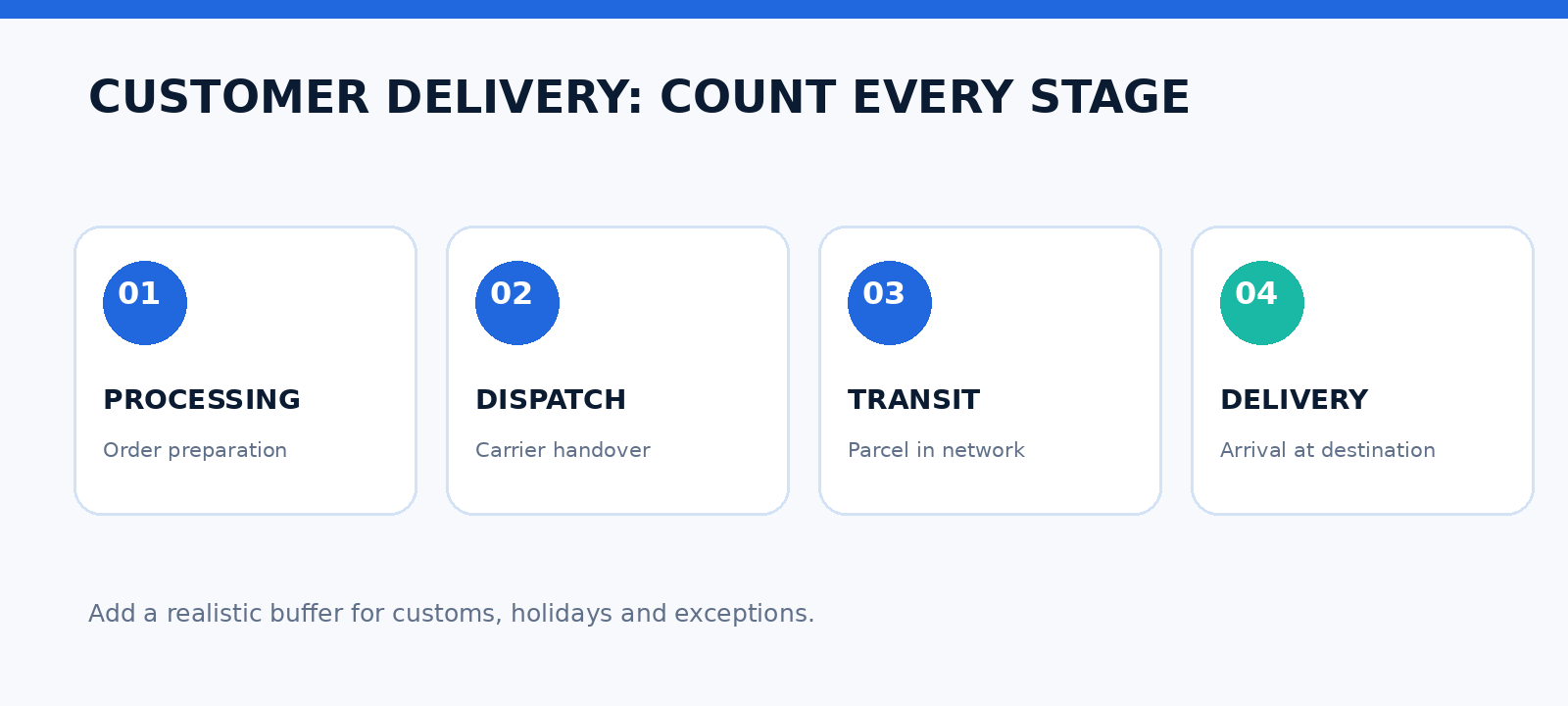
| Stage | What it means | Evidence to obtain |
|---|---|---|
| Processing | Payment accepted, order reviewed and prepared | Supplier order timestamps |
| Dispatch | Parcel handed to carrier | Carrier acceptance scan |
| Transit | Movement through the delivery network | Tracking history |
| Border handling | Customs and import processes, when relevant | Shipping terms and sample results |
| Delivery | Parcel reaches the customer's stated destination | Delivery confirmation |
Ask each potential supplier which milestone starts its quoted delivery clock. A label created in a system does not necessarily mean that the carrier has collected the parcel.
How long does dropshipping take in the UK?
There is no universal dropshipping delivery time. Timing varies with the actual stock location, fulfilment operation, destination, carrier, product restrictions and border requirements. Do not present a single global figure as a guaranteed UK delivery estimate.
For a planning scenario, imagine a supplier taking two working days to process an order and a carrier taking four working days after dispatch. The basic estimate is six working days before considering holidays, exceptions or any customs delay. This is a hypothetical illustration, not a benchmark for all suppliers.
A different supplier may advertise a UK warehouse, but that claim should be checked with real dispatch scans and a sample delivered to your target postcode. A UK company address does not prove that its stock is stored in the UK.
What UK sellers must disclose about delivery
UK government guidance for online and distance selling says businesses must provide clear delivery arrangements, costs and expected timing before the customer places an order. Online sellers must communicate total delivery costs or how those costs are calculated. GOV.UK also states that goods should be delivered within 30 days unless a different timeframe has been agreed. The applicable legal treatment depends on the contract and circumstances; this is general information, not legal advice. [1][2]
Section 28 of the Consumer Rights Act 2015 sets out delivery duties and remedies when an agreed or applicable delivery timeframe is missed. Where no delivery time is agreed, the trader must deliver without undue delay and in any event within 30 days; an agreed timeframe can be different. A delivery estimate must not conceal an unrealistic processing delay or unexpected extra charge. [3]
A practical delivery-promise policy
Before advertising a product, prepare a documented range based on completed sample orders, not the supplier's best-case marketing claim. Record processing time separately from shipping time; specify whether estimates use working days; explain when tracking becomes available; describe how delays are communicated; and make the returns and cancellation process accessible.
Review the promise for each country served. A delivery estimate demonstrated for London does not automatically apply to rural Scotland, Northern Ireland or an international destination.
Calculate the true shipping cost per order
Shipping cost is more than the number shown on a supplier's product page. Depending on the order, relevant costs may include packaging, per-order fulfilment, shipping service, tracking, failed delivery, replacement parcels and border charges. Include taxes correctly for your actual business model, rather than assuming a single VAT treatment for every order.
| Cost component | Supplier A | Supplier B |
|---|---|---|
| Product cost | £11.00 | £9.00 |
| Fulfilment/packaging | £0.75 | £1.25 |
| Tracked shipping | £3.50 | £6.00 |
| Expected issue allowance | £0.75 | £1.75 |
| Modelled cost per order | £16.00 | £18.00 |
The example is fictional. Supplier A: £11.00 + £0.75 + £3.50 + £0.75 = £16.00. Supplier B: £9.00 + £1.25 + £6.00 + £1.75 = £18.00. Although B has a £2 lower product price, its total in this scenario is £2 higher per order.
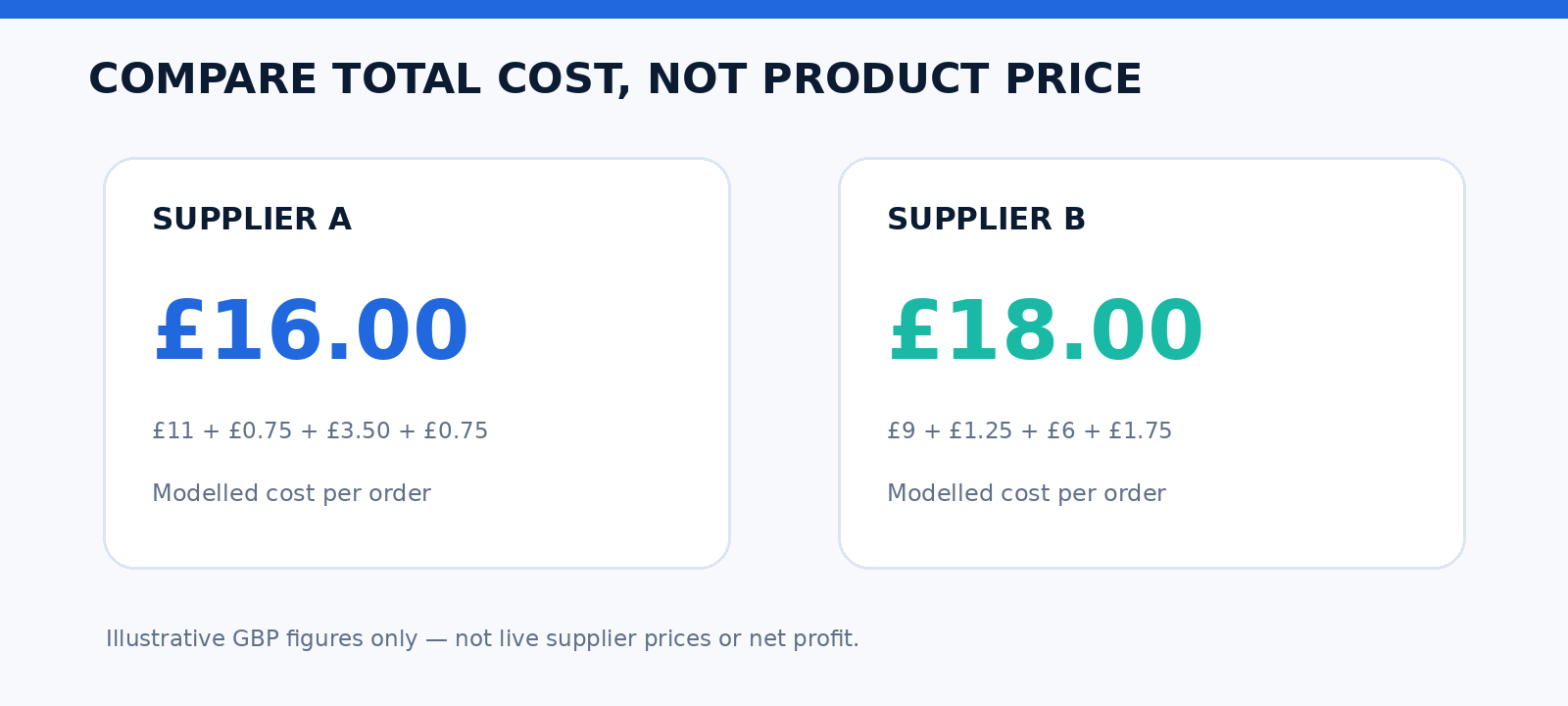
At a hypothetical selling price of £32, the remaining contribution is £16 for Supplier A and £14 for Supplier B before advertising, platform subscriptions, payment fees, applicable taxes and other costs. These amounts are not net profit.
For a fuller model, see the DropToolKit pricing guide, profit margins guide and break-even ROAS guide.
Free shipping versus paid shipping
“Free shipping” generally means that the store absorbs or includes shipping costs in the product price; it does not mean fulfilment costs disappear. Compare strategies using the same total amount paid by the customer and the same margin assumptions.
For example, a product priced at £30 with a £4 delivery charge costs the customer £34, while an advertised £34 product with delivery included also costs £34. The customer-facing choice can affect expectations and conversion, but neither arrangement increases margin by itself. Make charges clear before checkout and avoid surprising shoppers with mandatory fees late in the process. [1][4]
UK and international suppliers: questions that change the calculation
Domestic dispatch may reduce border complexity for UK orders, but should still be verified. International dispatch can introduce customs duties, import VAT arrangements, carrier handling and more complex returns. These vary with the type and value of goods, where they originate and who acts as importer. Consult current HMRC/GOV.UK guidance and obtain qualified advice for specific trading arrangements; do not copy a generic VAT assumption into every product listing. [5]
In particular, distinguish the supplier's invoice, shipping charge, the cost charged at checkout and any payment collected from the customer by a carrier. Unexpected import charges can create refunds, complaints and delivery refusals.
A supplier shipping test before launch
Use two or more sample orders where practical, addressed to representative customer destinations. Record the dates at each stage and ask the supplier to explain delays. Verify that tracking shows real carrier handover and that delivery claims match the evidence.
| Test | Pass condition | Evidence |
|---|---|---|
| Processing | Actual dispatch matches stated handling range | Order and carrier scan timestamps |
| Tracking | Carrier movement appears after handover | Tracking history |
| Cost | All quoted per-order charges are documented | Itemised quote and invoice |
| Packaging | Item arrives safely and as described | Photos and damage notes |
| Exception handling | Supplier gives a workable lost/damaged parcel process | Written policy and support response |
| Delivery estimate | Published range reflects sample results and sensible buffer | Dated testing log |
No small sample proves future performance. Repeat the test if the warehouse, shipping method or destination changes. Combine the findings with the reliable-suppliers checklist and product validation guide.
What to do when a dropshipping order is late
First, verify the actual order and carrier events. Then contact the supplier with the order number and agreed service level, provide the customer with an honest update, and document the action taken. Do not describe a parcel as dispatched merely because a shipping label exists.
Where the seller is responsible for delivery under the consumer contract, a private supplier agreement does not erase the retailer's consumer-law obligations. Review the applicable rules on delayed delivery, cancellation and refunds. GOV.UK explains standard refund and distance-selling cancellation requirements, including relevant exceptions. [2][3][6]
Common shipping mistakes
Using the fastest advertised estimate. One successful parcel is not a reliable delivery-time policy. Measure multiple orders and include realistic variance.
Ignoring processing time. Carrier transit begins after actual handover, not at checkout.
Comparing quotes with different inclusions. A carrier-only price is not comparable with an all-in fulfilment quote.
Hiding the origin of fulfilment. Be transparent about expected timing and any import implications.
Treating every refund as a supplier problem. Map the customer's rights and your obligations before negotiating reimbursement with the supplier.
Frequently asked questions
Can dropshipping orders arrive quickly in the UK?
They can, but speed depends on stock location, the supplier's processing operation and the carrier service used. Verify real shipments before making a specific promise.
Is free shipping better for conversions?
Not universally. Test the complete customer price, clarity at checkout and actual margin rather than assuming that the word “free” guarantees better results.
Who pays customs charges on international dropshipping orders?
That depends on the transaction structure, applicable tax and customs rules, shipping terms and who is the importer. Disclose relevant costs accurately and seek advice for your exact arrangement. [5]
Does a supplier's promised delivery date protect the retailer?
Not automatically. The consumer-facing seller must understand its own duties under the contract and relevant consumer law. [2][3]
How many sample orders should I place?
Use enough independent deliveries to identify obvious problems across the destinations and methods you intend to offer. There is no fixed number that guarantees supplier reliability.
Final checklist before taking orders
Confirm the item is legal and suitable for its destination; verify the actual warehouse origin; collect sample dispatch and transit evidence; obtain an all-in cost breakdown; document exception handling; publish a clear delivery range; and calculate your margin with realistic fulfilment allowances. For a broader budgeting view, read the advertising budget guide and use the DropToolKit Profit Calculator with the correct currency and cost assumptions.
Sources and further reading
- GOV.UK — Online and distance selling: Online selling
- GOV.UK — Online and distance selling: Distance selling
- Consumer Rights Act 2015 — Section 28: Delivery of goods
- Competition and Markets Authority — Consumer law guidance
- GOV.UK — Tax and customs for goods sent from abroad
- GOV.UK — Accepting returns and giving refunds