
If you sell a product for £50 and spend £15 to get the order, a 3.33x ROAS can look encouraging.
It may still be unprofitable.
ROAS measures the conversion value recorded for advertising divided by advertising spend. It does not automatically deduct product cost, shipping, payment fees, refunds or your store’s fixed costs. Google defines ROAS as total conversion value divided by total spend, so the result is only as useful as the value and costs you choose to measure.1
That is why break-even ROAS should start with your order economics, not with a universal advertising target.
This guide shows a practical method using an illustrative £50 order. Replace every illustrative figure with your own supplier invoices, delivery charges, payment terms, refund data and operating costs before making a campaign decision.
Important: This is a calculation guide, not tax, accounting, legal or advertising advice. It is written for the 2027 planning horizon, but no 2027 prices, supplier charges, platform policies or market statistics are assumed.
What break-even ROAS means
Break-even ROAS is the minimum return on ad spend required for an order to cover the costs included in your model, leaving £0 of the profit target you set.
It is usually expressed as either a multiple or a percentage:
- A 3.174603x ROAS means £3.174603 of attributed conversion value for each £1 spent on ads.
- 317.5% is an appropriately rounded percentage representation of that illustrative threshold.
The formula is:
ROAS = attributed conversion value ÷ advertising spend
For a simple one-order model, if the value recorded is VAT-exclusive order revenue, then:
Break-even ROAS = VAT-exclusive revenue per order ÷ allowable acquisition cost per order
The critical phrase is allowable acquisition cost. It is not a standard percentage. It is the amount left for advertising after the costs and profit target that your model includes.
Use the same basis on both sides of the comparison
If your advertising platform reports revenue-based conversion value, compare its ROAS with a revenue-based break-even model such as the £50 example in this guide. Do not call revenue-based ROAS a profit result simply because the number is high.
If you send a profit-based conversion value to an advertising platform, use a separately documented, consistently profit-based model. Its treatment of product cost, fees, refunds, tax and fixed costs must match the value being reported. Do not compare a profit-based campaign ROAS directly with a revenue-based threshold without converting one basis to the other.
In either case, keep attribution period, conversion definition, reporting period and refund treatment aligned. For example, comparing seven-day attributed gross revenue with a 30-day net-refund cost model can create a precise-looking but inconsistent result.
ROAS is not profit, CPA, CAC or conversion rate
These measures answer different questions. Mixing them together is one of the quickest ways to misread an advertising result.
| Measure | What it shows | Basic calculation | What it does not show by itself |
|---|---|---|---|
| ROAS | Recorded conversion value returned for ad spend | Conversion value ÷ ad spend | Product costs, fees, refunds or fixed costs unless the reported conversion value and model account for them consistently |
| Profit | What remains after the costs included in the calculation | Revenue − costs | Whether attribution or tracking is complete |
| CPA | Advertising cost per attributed conversion/order | Ad spend ÷ attributed orders | Profitability without the order’s non-ad costs |
| CAC | Cost to acquire a customer; scope varies by business | Acquisition spend ÷ new customers acquired | A universal equivalent of CPA; repeat customers and non-ad acquisition may change it |
| Conversion rate | Share of a defined audience that converts | Orders ÷ clicks × 100, when click-to-order is the chosen definition | Revenue, margin or acquisition cost |
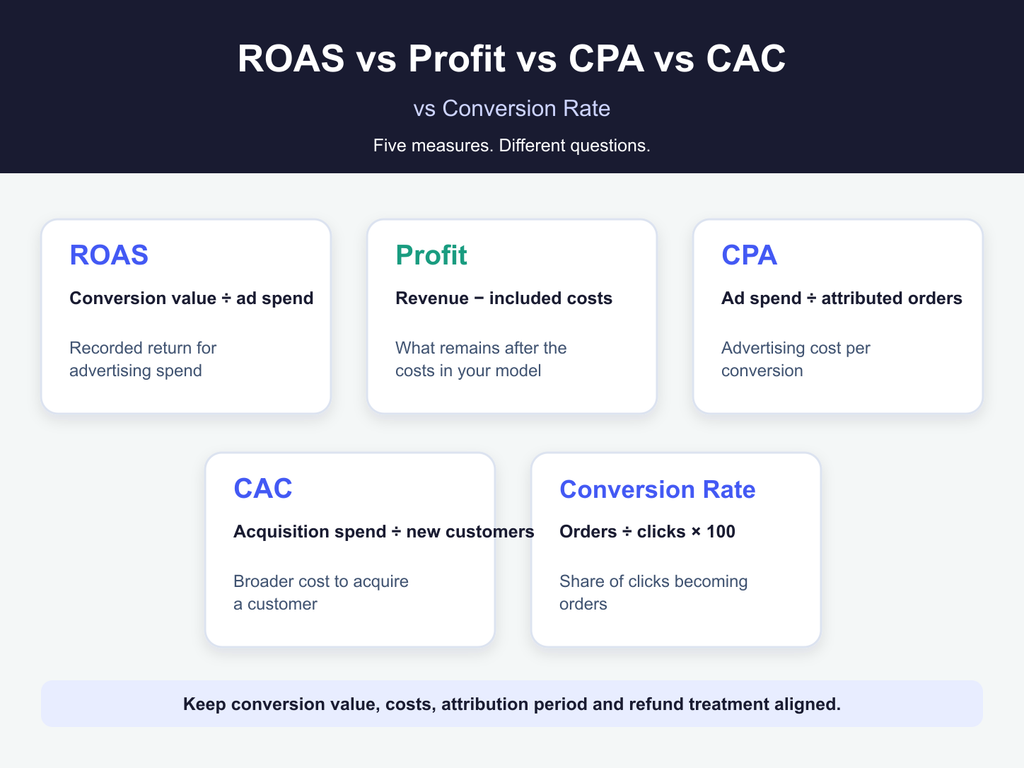
Google’s advertising glossary defines CPA as total cost divided by total conversions, and ROAS as total conversion value divided by total spend.1 In a paid campaign where each conversion is one order, CPA may be the campaign’s ad cost per order. CAC is often broader: a business might calculate it for new customers only and include more than one marketing channel. Define the scope before comparing either metric.
Conversion rate affects CPA but is not a profit measure. If clicks cost the same, a better click-to-order conversion rate can reduce CPA. With matching definitions:
CPA = cost per click ÷ conversion rate (as a decimal)
For example, £0.50 CPC and a 2% click-to-order conversion rate imply £25 CPA (£0.50 ÷ 0.02). That tells you whether the traffic converts efficiently, not whether the order is profitable.
Start with contribution before advertising
Before calculating a ROAS target, work out what one order contributes before paid acquisition.
Contribution before advertising = revenue − non-ad variable costs
Non-ad variable costs normally include costs that move with the sale, such as:
- product cost;
- supplier shipping or fulfilment charge;
- payment processing percentage and fixed fee;
- marketplace or transaction charges that apply to the order;
- an evidence-based refund, return or chargeback allowance; and
- any other per-order cost you can identify.
Keep fixed costs separate at first. A monthly ecommerce subscription or software bill does not rise automatically with every individual sale, even though it still matters to the business. A fixed-cost allocation is a planning assumption, not a universal accounting rule. State the expected order volume and review it when actual volume changes.
A complete illustrative £50 order calculation
The following amounts are a DropToolKit illustration only. They are deliberately not presented as live supplier pricing, a payment-provider quote, a refund rate or a typical result. The £50 revenue and all cost figures are VAT-exclusive for this worked example.
| Item | Type | Illustrative amount | Why it is included |
|---|---|---|---|
| Customer order revenue | Revenue | £50.00 | The value attributed to the order, before VAT for a VAT-exclusive model |
| Product cost | Variable | −£26.00 | Supplier item charge assumed for this example |
| Supplier shipping/fulfilment | Variable | −£4.00 | Delivery charge absorbed by the merchant in this example |
| Payment processing | Variable | −£1.25 | Assumed order-level charge; not a quotation or a provider rate |
| Refunds/returns loss allowance | Variable | −£1.00 | Planning assumption only; replace with actual data when available and do not double count it |
| Contribution before advertising | £17.75 | £50.00 − £26.00 − £4.00 − £1.25 − £1.00 | |
| Fixed-cost allocation | Planning allocation | −£2.00 | Illustrative share of subscriptions, software and support costs across expected paid and organic orders |
| Allowable acquisition cost at break-even | £15.75 | £17.75 − £2.00 − £0.00 target profit | |
| Desired pre-tax profit per order | Target | −£2.00 | A chosen target, not a cost or guarantee |
| Allowable acquisition cost at target profit | £13.75 | £17.75 − £2.00 − £2.00 |
Check the arithmetic and the rounding
Contribution before advertising:
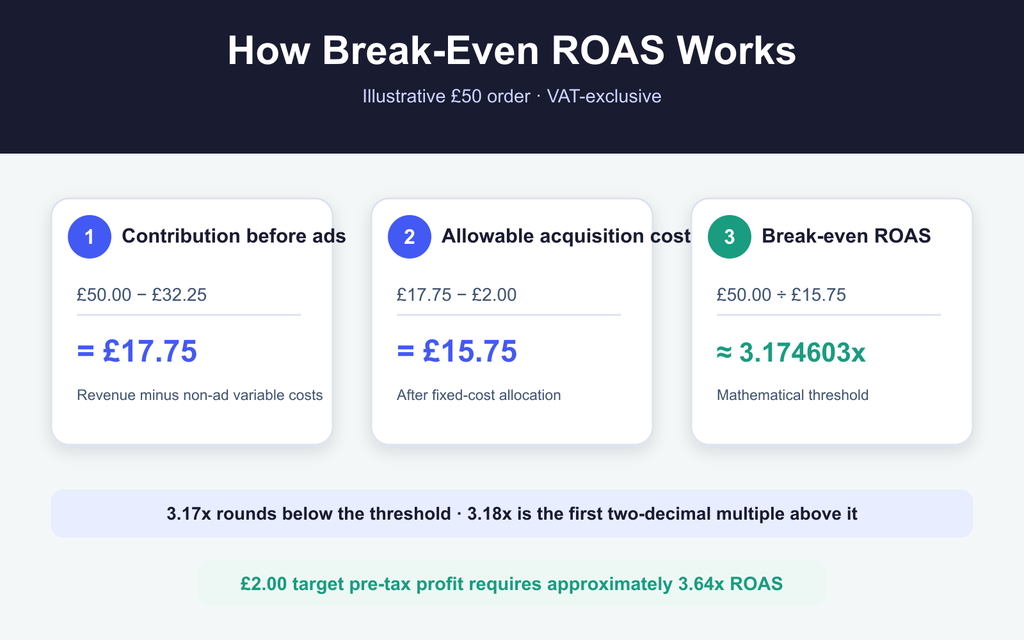
£50.00 − £26.00 − £4.00 − £1.25 − £1.00 = £17.75
Contribution before advertising margin:
£17.75 ÷ £50.00 × 100 = 35.5%
Break-even allowable acquisition cost after the £2 fixed-cost allocation:
£17.75 − £2.00 = £15.75
Break-even ROAS (non-terminating decimal):
£50.00 ÷ £15.75 = 3.1746031746…x
The mathematical break-even threshold is therefore approximately 3.174603x, or 317.5% when expressed as an appropriately rounded percentage.
3.17x is only a rounded display value; it is slightly below the precise 3.174603x threshold. If a two-decimal multiple must not fall below this model’s break-even point, use 3.18x. A prudent operational target should normally sit above mathematical break-even to allow for normal variation, attribution delay and assumptions that later prove optimistic; the size of that buffer is a business decision, not a universal rule.
Target ROAS with a £2 pre-tax profit target:
£50.00 ÷ £13.75 = 3.6363636363…x
Rounded sensibly, the target ROAS is 3.64x, or 363.6%. At £13.75 advertising cost per order, the model leaves £2.00 after the listed costs and the fixed-cost allocation.
The figures are not conflicting targets:
- 3.174603x is the illustration’s mathematical break-even point after the listed fixed-cost allocation.
- 3.18x is the first two-decimal multiple above that mathematical threshold.
- 3.64x includes the illustration’s £2 per-order pre-tax profit target.
The reusable formula
Use one consistent currency and one tax basis throughout.
Let:
- R = VAT-exclusive revenue per order;
- V = total non-ad variable cost per order;
- F = fixed-cost allocation per order;
- P = desired pre-tax profit per order; and
- A = allowable acquisition cost per order.
Then:
Contribution before advertising = R − V
A = R − V − F − P
Break-even ROAS = R ÷ A, where P = £0
Target ROAS = R ÷ A, where P is your positive profit target
If A is zero or negative, no positive advertising spend can meet that model. The problem is the economics or the assumptions, not a missing ROAS “hack”.
This approach assumes that advertising spend and attributed orders use the same period and attribution method. A campaign ROAS can be misleading if the revenue is reported on one basis while spend, refunds or conversions are measured on another.
Why refunds, shipping and taxes change the answer
Refunds and returns
Revenue-based ROAS can overstate the economic result if it counts an order that is later refunded. A refund can involve more than refunded revenue: you may also have unrecoverable supplier fulfilment or shipping charges, return-label or handling costs, and payment costs that your provider does not return. Which costs are recoverable depends on the supplier, carrier, provider and transaction.
For planning, you can either use net realised revenue once enough data is available, or apply a conservative, clearly labelled loss allowance supported by your own data. If you have no business data yet, any allowance is illustrative rather than a market fact. Define what that allowance covers. For example, it may cover the expected net loss from refunded revenue plus unrecoverable fulfilment, return and payment costs.
Do not count the same loss twice. If your conversion value is already net of refunds, do not subtract refunded revenue again. If an allowance already includes unrecoverable fulfilment and payment costs, do not add the same expected costs elsewhere in the model.
Chargebacks can create additional costs. Payment-provider dispute fees and outcomes vary, so use your provider agreement and historic data rather than inserting a generic market figure. Stripe, for example, publishes pricing by card type and separate dispute-fee information; its figures are provider-specific and must be refreshed before operational use.2
Shipping
“Free shipping” to the customer is not free to the merchant. Include the supplier’s delivery/fulfilment charge unless it is genuinely already included in the product cost used in your model. If you charge the customer for delivery, decide whether the reported conversion value and product revenue include that amount, then use that decision consistently.
VAT and other tax considerations for UK sellers
This example uses VAT-exclusive revenue and costs. That is often a clearer economic basis for a VAT-registered business where input VAT is recoverable, but it is not automatically correct for every seller, transaction or supply chain.
HMRC explains that VAT-registered businesses normally account for output tax on taxable supplies and may reclaim eligible input tax on business purchases; the VAT return settles the difference.3 This does not mean every amount of VAT is recoverable or that every dropshipping arrangement has the same treatment. Registration status, product, place of supply, imports, customer location, supplier terms and evidence can change the result.
For a VAT-inclusive customer price, do not compare the full customer payment against VAT-exclusive costs without adjusting it. For a VAT-registered business, build the model on a consistent VAT-exclusive basis and seek advice for your specific arrangement. Check current HMRC registration guidance and thresholds rather than repeating an old number in a planning article.4
Corporation tax, income tax and customs/import obligations are also outside this simple per-order ROAS calculation. Break-even ROAS is an operating measure; it is not an after-tax profit forecast.
Fixed costs
Fixed costs can make a campaign appear profitable per order while the business as a whole still loses money.
To include them for planning, choose and state an expected total order volume:
Fixed-cost allocation per order = monthly fixed costs ÷ expected paid and organic orders for the month
If monthly fixed costs are £200 and you expect 60 paid orders plus 40 organic orders, the transparent planning allocation is £2 per order (£200 ÷ 100). It affects the estimate because the same £200 would be £3.33 per order if you forecast only 60 total orders, or £1 per order if you forecast 200 total orders.
This allocation does not make the £2 a new per-order charge or establish a universal accounting rule. It is a way to test whether a campaign’s contribution could support the wider business under stated volume assumptions. Review the assumptions as actual paid and organic order mix changes.
Try this before using a calculator
Use a note or spreadsheet and complete these five lines using one tax basis and one reporting period:
- Write your revenue per order (R).
- Subtract product, shipping, payment and any evidence-based refund/return costs to find R − V.
- State your expected paid and organic order volume, then choose a transparent fixed-cost allocation (F) if you need one.
- Choose £0 for mathematical break-even, or state your desired pre-tax profit (P), then calculate A = R − V − F − P.
- Calculate R ÷ A. If A is zero or negative, revise the economics before spending on ads.
Only then enter the matching cost set in the relevant DropToolKit Profit Calculator or DropToolKit Ad ROI Calculator. Keep a note of what you included, especially if you fold refund losses or fixed-cost assumptions into a calculator field.
How to calculate break-even ROAS in five steps
1. Choose the value that your ads report
For a beginner ecommerce model, start with the VAT-exclusive order value actually tracked as conversion value. That creates a revenue-based ROAS, so use a revenue-based cost model when testing it. If you later use profit-based conversion values, document their calculation and use a separately consistent profit-based model rather than comparing them with a revenue threshold.
Google Ads states that conversion values can represent different business values, including sales revenue or profit margins. It also notes that transaction-specific values are more representative when transactions vary.5 The platform does not decide your true profit for you: your conversion-value definition, attribution settings, refund handling and cost model do.
2. List every non-ad variable cost
Use supplier invoices, fulfilment terms, payment-provider pricing, platform statements and your own returns data. Treat a payment fee as a specific provider and payment-method assumption, not as a universal ecommerce percentage. For context, Stripe’s UK pricing page currently shows different published rates for standard UK, premium UK, EEA and other international cards, with extra currency-conversion charges in some cases.2
3. Calculate contribution before advertising
Subtract the non-ad variable costs from revenue. This tells you the maximum amount available for advertising, fixed costs and profit.
4. Reserve fixed costs and a profit target
For a short test, you may first examine contribution before advertising. For a business decision, state an expected paid-and-organic order volume, reserve a transparent fixed-cost allocation and choose a profit target. The remaining amount is the allowable acquisition cost.
5. Divide revenue by allowable acquisition cost
The result is your mathematical break-even or target ROAS. Compare it with actual ROAS only after checking that conversion value, attribution window, conversion definition, refund treatment and reporting period match the model.
Using the DropToolKit calculators without overstating them
The DropToolKit Profit Calculator accepts selling price, units per order, product cost, shipping cost, a platform-fee percentage, a flat transaction fee, ad spend per order and tool cost per order. It reports net profit per order, profit margin, total costs, break-even CPA and an approximate GBP view from USD inputs.6
Use it to test a defined cost set, then compare its break-even CPA with the allowable acquisition cost from your own model. It does not have a dedicated refunds/returns allowance, fixed-cost allocation or desired-profit field. If you include those costs, document how you folded them into the entered figures so that you do not lose the audit trail.
The DropToolKit Ad ROI Calculator accepts campaign ad spend, impressions, clicks, conversions, average order value, product-plus-shipping cost, percentage platform fee and a flat transaction fee. It reports ROAS, net campaign profit, net ROI, CPC, actual CPA, conversion rate, gross revenue and break-even CPA.7
Use it to assess a campaign with stated inputs. It likewise does not have dedicated refund, chargeback or fixed-cost inputs, and its first-party inputs are USD with an approximate GBP conversion. The calculator is a planning aid, not accounting software and not a guarantee that a campaign will be profitable.
Internal reading to add context
Before calculating a ROAS target, read How Much Does It Cost to Start Dropshipping in 2026? A Realistic Beginner Budget for a wider look at planning costs beyond one order.
For the underlying order-margin method, see Dropshipping Profit Margins Explained: What Beginners Should Really Expect in 2026.
Common break-even ROAS mistakes
Treating a 3x ROAS as automatically profitable
A 3x ROAS means £3 of tracked conversion value for each £1 of ad spend. Whether that is enough depends on what remains after the order’s actual costs. A £50 order with £15.75 allowable acquisition cost needs approximately 3.174603x to break even. At 3x, advertising cost is about £16.67 per order, which is about £0.92 above this illustration’s break-even acquisition cost.
Rounding a break-even figure down
In this illustration, 3.17x is below the precise 3.174603x threshold. Use 3.18x as the minimum two-decimal multiple above it, then set a prudent operational target above break-even if your business needs room for uncertain inputs or variation.
Using gross revenue after refunds have started
If refunds rise, the revenue used for ROAS may no longer represent retained sales. Recalculate the allowance or use net realised revenue where your reporting allows it, and keep unrecoverable fulfilment, return and payment costs from being counted twice.
Forgetting fixed costs because they are not charged per order
Fixed costs do not disappear merely because they are paid monthly. Use a stated order-volume assumption for planning and revisit it as paid and organic order mix changes.
Copying a payment percentage from another business
Provider, plan, card type, customer location, currency conversion and transaction type can change fees. Use a current, primary provider price page or your own statement, and record the date checked.
Confusing a target with a promise
A target ROAS is a decision threshold under stated assumptions. It is not evidence that an ad platform will deliver that result, and it is not a promise of profit.
Frequently asked questions
What is a good break-even ROAS for dropshipping?
There is no universal number. Calculate it from your own revenue, product cost, shipping, payment fees, refund loss treatment, fixed-cost allocation and profit target. A ROAS that works for one product can lose money on another.
Is 3.17x enough if my exact break-even ROAS is 3.174603x?
No. 3.17x is slightly below that exact threshold. If you need a two-decimal multiple that is not below it, use 3.18x. A prudent operating target may need to be higher, depending on the reliability of your inputs and the buffer you choose.
Is break-even ROAS the same as profit?
No. Break-even ROAS is an advertising-efficiency threshold based on a chosen model. Profit is what remains after the costs actually included. A revenue-based ROAS can look strong while profit is weak or negative.
How do I calculate allowable CPA?
Subtract non-ad variable costs, fixed-cost allocation and your desired pre-tax profit from revenue. At break-even, set the desired profit to £0. The result is the maximum ad cost per order under that model.
How do refunds affect ROAS?
Refunded revenue, unrecoverable fulfilment or shipping, return costs and payment costs may affect the result differently. Use net realised revenue or a clearly defined, evidence-based loss allowance, and do not subtract the same expected loss twice.
Should I include VAT in break-even ROAS?
Use one consistent tax basis. For a VAT-registered business with recoverable input VAT, a VAT-exclusive model may be appropriate, but treatment depends on the facts. Do not mix VAT-inclusive sale prices with VAT-exclusive costs without adjustment; seek professional advice for your setup.
Can a campaign meet ROAS target and still be unprofitable?
Yes. This can happen when the target excludes refunds, fixed costs, taxes, chargebacks, untracked costs or when the conversion-value, attribution and cost bases are inconsistent.
Conclusion
Break-even ROAS is not a number to copy from a forum, platform or competitor. It is the result of a transparent cost model.
Start with contribution before advertising. Include your supplier and shipping cost, payment charges and a clearly defined refund-loss treatment. State how you allocate fixed costs and what paid-and-organic order volume that assumes. The remaining amount is your allowable acquisition cost, and revenue divided by that amount is your mathematical ROAS threshold.
For the £50 illustration, that threshold is approximately 3.174603x: 3.17x is below it, while 3.18x is the first two-decimal multiple above it. Use a prudent operational target above mathematical break-even where your business needs a buffer. Check your inputs regularly, especially provider fees, supplier charges, tax treatment, refund data, attribution settings and the conversion-value definition in your ad account.
Source notes
- Google Ads Help, Glossary. Reviewed 22 October 2026. ↩
- Stripe, Pricing and fees for UK businesses. Reviewed 22 October 2026. ↩
- HMRC, VAT guide (VAT Notice 700). Reviewed 22 October 2026. ↩
- HMRC, Register for VAT. Reviewed 22 October 2026. ↩
- Google Ads Help, About conversion values. Reviewed 22 October 2026. ↩
- DropToolKit, Profit Calculator. Interface reviewed 22 October 2026. ↩
- DropToolKit, Ad ROI Calculator. Interface reviewed 22 October 2026. ↩