
Dropshipping can look deceptively simple on paper.
You find a product for £30, sell it for £50, and it appears that you have made £20 profit.
But that £20 is not necessarily the amount you keep.
Payment processing, advertising, refunds, apps, platform fees and other operating costs can reduce an apparently healthy product margin very quickly.
That is why understanding your dropshipping profit margin matters more than simply comparing your supplier cost with your selling price.
In this guide, we will break down gross margin, contribution margin and net profit, look at realistic dropshipping margin ranges, and show how the economics of a single order can change once all the relevant costs are included.
What Is a Dropshipping Profit Margin?
Profit margin shows how much profit remains from revenue after a specified set of costs has been deducted. Which costs are included determines whether the metric is gross, contribution or net margin.
The basic formula is:
Profit Margin = Profit ÷ Revenue × 100
For example, if you generate £100 in revenue and £20 remains as profit:
£20 ÷ £100 × 100 = 20% profit margin
The important question, however, is:
Which costs have already been deducted from that £100?
That is where many beginner calculations become misleading.
A margin calculated only after supplier costs is very different from a margin calculated after advertising, payment fees, refunds and operating expenses.
To understand whether a dropshipping product is genuinely profitable, it helps to separate three different levels of margin.
Gross Margin vs Contribution Margin vs Net Margin
Gross Margin
Gross margin looks at the relationship between your selling price and the direct cost of providing the product.
For a simplified dropshipping order:
- Selling price: £50
- Product and supplier shipping cost: £30
- Gross profit: £20
The gross margin is:
£20 ÷ £50 × 100 = 40%
At first glance, a 40% margin may look very attractive.
But it does not mean you keep £20 from the order.
Advertising, payment processing and other costs may still need to be deducted.
Contribution Margin
Contribution margin goes a step further.
It considers the variable costs associated with generating and processing the sale.
Depending on your business, those may include:
- payment processing fees;
- advertising or customer acquisition cost;
- marketplace or transaction fees;
- refund and return allowances;
- fulfilment-related charges;
- other costs that increase as you generate more orders.
Contribution Margin = (Revenue − All Variable Costs) ÷ Revenue × 100
Contribution margin can therefore give you a much better picture of whether an individual product or order is economically viable.
A product with a strong gross margin but a weak contribution margin may be difficult to scale profitably.
Net Profit Margin
Net profit margin looks at the wider business.
In addition to product and variable costs, it may include expenses such as:
- ecommerce platform subscriptions;
- paid apps;
- software;
- customer support;
- contractors;
- accounting;
- other overhead.
Net profit margin reflects the wider business result after applicable expenses and taxes. Tax treatment varies by country, business structure and circumstances. For a UK VAT-registered business, VAT collected on sales is generally excluded from VAT-exclusive revenue, and recoverable input VAT is generally excluded from expenses. Use a consistent VAT basis in each calculation.
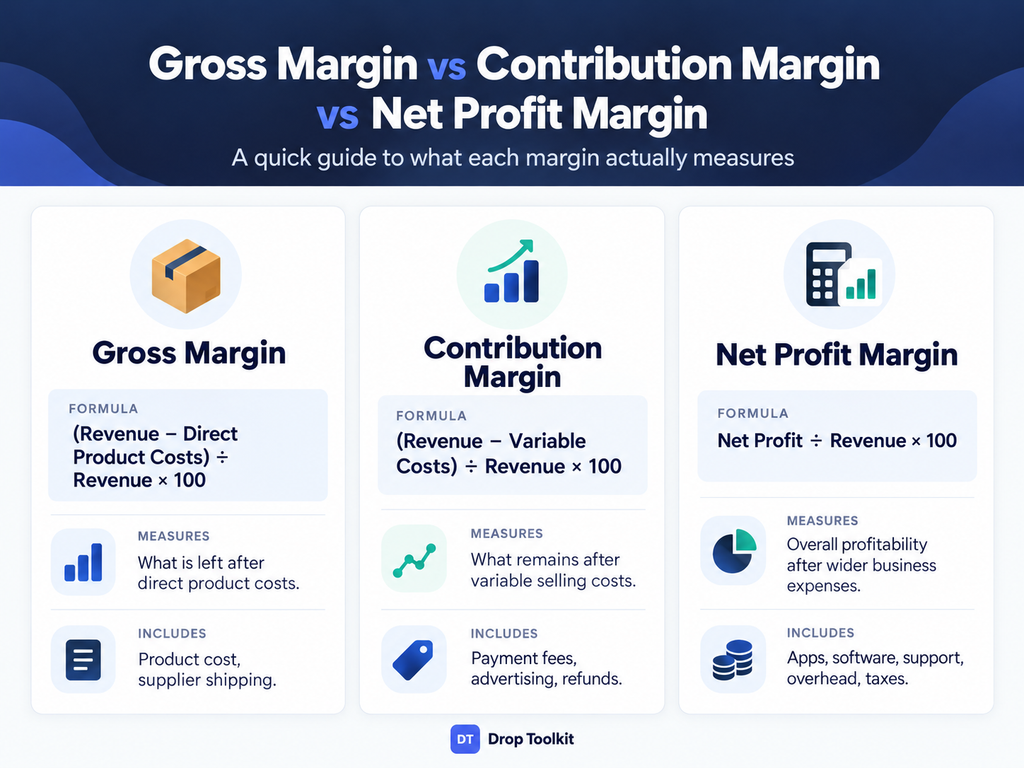
The key distinction is simple:
Gross margin shows what remains after direct product costs. Contribution margin accounts for all variable costs. Net margin reflects wider expenses and applicable taxes.
What Profit Margins Are Common in Dropshipping?
There is no single universal dropshipping profit margin.
Different sourcing models can produce very different economics.
Shopify has published examples indicating margins of around 10%–15% for some products sourced through open marketplaces, while some established supplier-network models may offer margins in the 20%–50% range.
These Shopify-published figures describe different sourcing models, are not guaranteed results or a universal industry average, and should not automatically be interpreted as after-expense net margins.
Your actual result may be affected by:
- the niche;
- supplier pricing;
- product quality;
- shipping cost;
- competition;
- customer acquisition cost;
- payment method;
- return and refund rates;
- geography;
- pricing power;
- repeat purchases.
Two stores selling similar products can therefore have completely different profit margins.
This is also why a headline such as “dropshipping has a 30% margin” is not enough information to judge whether a business is actually profitable.
Why a 30% Product Margin Does Not Mean 30% Profit
Imagine you sell a product for £50.
Your supplier and shipping cost is £35.
That leaves:
£50 – £35 = £15
Your gross margin is:
£15 ÷ £50 × 100 = 30%
It would be easy to call that a £15 profit.
But the order may still need to pay for:
- payment processing;
- advertising;
- refund risk;
- apps;
- store costs;
- customer support;
- other business expenses.
Suppose another £11 of combined costs is associated with generating and supporting that order.
Your £15 gross profit could leave just £4 after those listed costs, before tax or other expenses.
£4 ÷ £50 × 100 = 8% margin after the listed costs.
The product still has a 30% gross margin, but the illustrative margin after the listed costs is only 8%.
That difference is one of the most important concepts for a beginner to understand.
The Costs That Reduce Your Dropshipping Margin
A realistic margin calculation needs to look beyond the supplier invoice.
Product Cost
This is the amount your supplier charges for the product itself.
It is normally the first cost beginners include — but it should not be the last.
Supplier pricing can also change over time, which means a product that works today may become less attractive later.
Shipping
Shipping may be charged separately or included in the supplier price.
Offering customers “free shipping” does not make the cost disappear.
It normally means the merchant absorbs the shipping expense or builds it into the selling price.
For margin calculations, the important figure is what shipping actually costs your business.
Payment Processing
Payment providers normally charge a percentage of the transaction plus, in many cases, a fixed amount.
For example, UK pricing from Stripe, Shopify and PayPal demonstrates that payment fees vary by provider, plan, card origin and transaction type. Their rates are alternatives, not multiple processing fees automatically charged on the same sale. Check published rates again before using them for a live business forecast.
The exact fee depends on your platform, provider, payment method, card origin and account terms.
Do not assume payment processing is negligible simply because the percentage looks small.
Advertising
For paid-traffic stores, customer acquisition can be one of the largest expenses.
A product may appear highly profitable before advertising and become unprofitable once you calculate how much it costs to generate each customer.
This is why gross product margin should never be analysed separately from advertising economics when paid acquisition is part of the strategy.
Platform and Transaction Fees
Your ecommerce platform may charge:
- subscription fees;
- transaction fees;
- additional fees for third-party payment providers;
- other service charges.
Some are fixed monthly expenses, while others increase with sales.
Both can affect profitability.
Apps and Software
A few inexpensive apps may not look significant individually.
But £5 here, £15 there and £30 somewhere else can quickly turn into a meaningful monthly cost.
Before adding another subscription, ask whether it solves a real business problem or produces enough value to justify its effect on your overhead.
Returns and Refunds
Not every order ends perfectly.
Some customers may:
- request refunds;
- return products;
- receive damaged items;
- receive incorrect orders;
- cancel transactions.
Your financial model should leave some room for these events rather than assuming every sale completes without friction.
Chargebacks and Failed Payments
Chargebacks, disputes and payment problems can create additional costs.
You do not need to build an elaborate forecast before your first sale, but ignoring these risks completely can make thin-margin products look healthier than they really are.
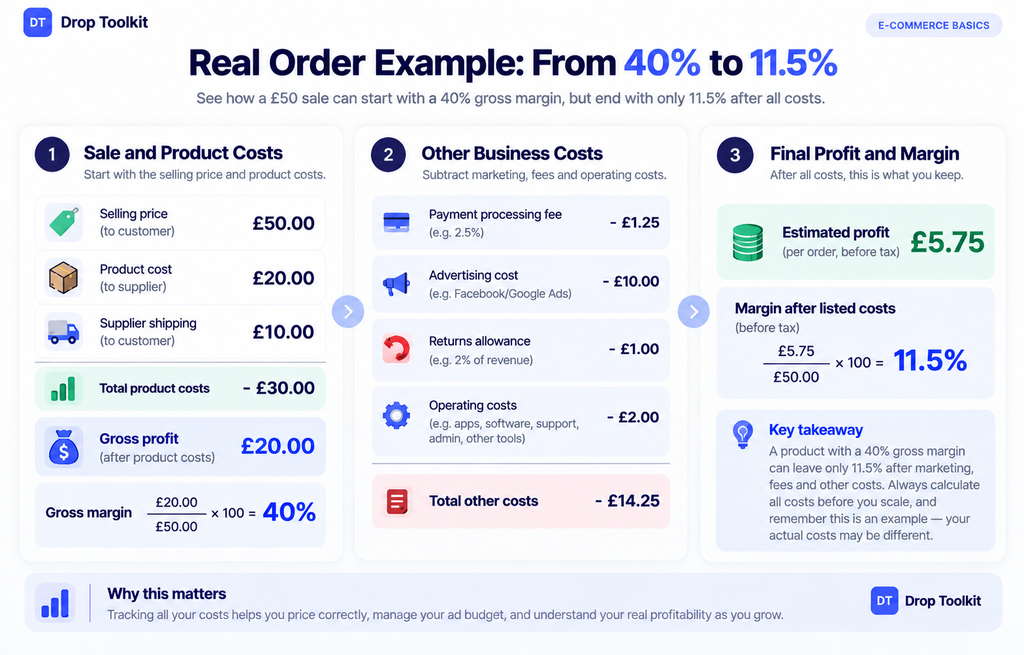
A Realistic £50 Order Example
The following is a DropToolKit illustrative scenario, not an industry benchmark.
Suppose a product sells for £50.
| Item | Amount |
|---|---|
| Selling price | £50.00 |
| Product + supplier shipping | −£30.00 |
| Gross profit | £20.00 |
| Payment processing | −£1.25 |
| Advertising allocation | −£10.00 |
| Expected returns/refund allowance | −£1.00 |
| Apps/operating allocation | −£2.00 |
| Remaining after listed costs | £5.75 |
Before the additional costs:
Gross margin = £20 ÷ £50 × 100 = 40%
After the illustrative additional costs (including a £2 allocation of overhead):
£5.75 ÷ £50 × 100 = 11.5%
That is a major difference.
The product started with a 40% gross margin, but only 11.5% of the sale price remains in this example after the additional costs included in the scenario.
The £2 operating allocation is a share of overhead, not a variable charge on every order. Before this allocation, the illustrative contribution is £7.75 (15.5%). After the listed allocations, the remaining amount is £5.75 (11.5%). This scenario is hypothetical, assumes VAT-exclusive amounts and does not show a definitive after-tax net profit. This is why looking only at the difference between selling price and supplier cost can give beginners an unrealistic view of profitability.
Profit Margin vs Markup
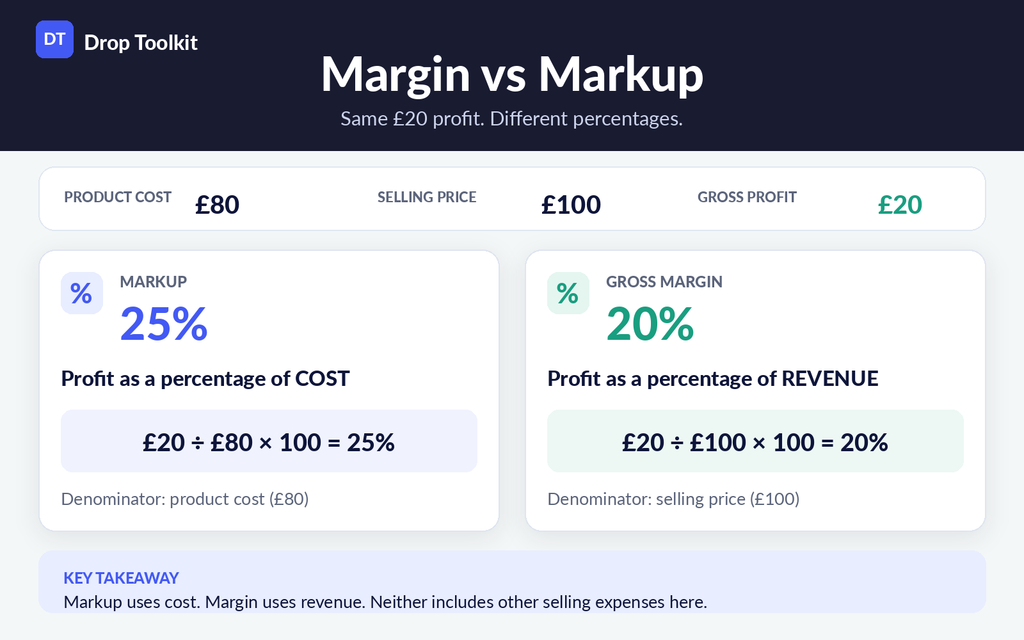
Margin and markup are related, but they are not the same thing.
Suppose a product costs £80 and sells for £100.
The profit before other costs is £20.
Markup
Markup compares the profit with the original cost:
£20 ÷ £80 × 100 = 25% markup
Margin
Margin compares the profit with the selling price:
£20 ÷ £100 × 100 = 20% gross margin
So the same product has:
- 25% markup
- 20% margin
Confusing these figures can lead to poor pricing decisions.
When analysing profitability, make sure you know which calculation a supplier, seller or article is referring to.
What Margin Should a Beginner Aim For?
There is no single percentage that automatically makes a dropshipping product good.
Instead of choosing a magic target, ask whether the product leaves enough room to cover the complete economics of the sale.
A workable product needs room for:
- supplier cost;
- shipping;
- payment fees;
- customer acquisition;
- refunds and returns;
- operating expenses;
- profit.
Published margin ranges can provide useful context, but they should not become rigid targets.
A product showing a 25% gross margin might work extremely well for a store with inexpensive organic customer acquisition.
The same product could lose money for another store paying heavily for advertising.
A more useful question is:
How much money remains after the realistic costs required to produce the sale?
That is the margin that matters.
How Paid Advertising Changes the Numbers
Advertising can completely change the profitability of a product.
Suppose your gross profit per order is £20.
If acquiring one customer costs £5, there may still be substantial room for payment fees and operating costs.
If acquiring that customer costs £15, only £5 remains before those additional expenses.
And if customer acquisition costs £22, the order is already negative before overhead.
This relationship is why dropshippers using paid advertising need to understand:
- customer acquisition cost;
- conversion rate;
- return on ad spend;
- break-even ROAS;
- profit per order.
The cheapest product is not necessarily the easiest product to advertise profitably.
A product with more pricing room may sometimes support paid acquisition better than a cheaper product with a thin margin.
Use the DropToolKit Ad ROI Calculator to explore how advertising spend, CPA, ROAS and other campaign costs affect your results.
Returns, Refunds and Payment Fees
Margin calculations often assume the perfect order:
The customer pays, the supplier ships, the customer is satisfied and nothing goes wrong.
Real businesses are not that clean.
Some transactions will create additional costs.
Rather than pretending those costs do not exist, you can build a modest allowance into your financial planning and replace your assumptions with real business data once you have enough orders.
This is particularly important for thin-margin products.
If you make only a few pounds from each successful order, a single refund or chargeback may consume the profit from several other sales.
When a Product Is Too Low-Margin to Test
Low margin does not automatically mean a bad product.
Large businesses can operate successfully on relatively small margins when they have:
- strong purchasing power;
- high order volume;
- efficient acquisition;
- repeat customers;
- sophisticated fulfilment;
- excellent operational control.
A beginner usually has fewer of those advantages.
Warning signs that a product may be financially difficult include:
- very little margin after supplier and shipping costs;
- profitability that depends on extremely cheap advertising;
- one refund eliminating the profit from several successful orders;
- intense competition limiting your ability to raise prices;
- highly variable shipping costs;
- payment charges taking a meaningful share of profit;
- profitability disappearing once basic operating costs are included.
Before rejecting or accepting a product, run the complete numbers.
A product should survive a realistic calculation, not only the best-case scenario.
How to Improve Dropshipping Profit Margins
Improving profit margin does not always mean simply increasing your price.
There are several areas you can work on.
Negotiate Supplier Pricing
As order volume increases, some suppliers may be willing to offer better pricing or shipping arrangements.
Even a modest reduction in unit cost can improve your economics across every order.
Compare Suppliers
Do not evaluate suppliers on price alone.
Consider:
- product quality;
- shipping;
- reliability;
- fulfilment speed;
- communication;
- refund handling.
A cheaper supplier that creates more customer problems can become more expensive overall.
Increase Average Order Value
Bundles, complementary products and sensible upsells can increase revenue without requiring a completely new customer acquisition.
Improve Conversion Rate
If more visitors become customers, your effective acquisition cost can improve because more sales are generated from the traffic you already paid for.
Reduce Unnecessary Apps
Review recurring software subscriptions periodically.
If an app no longer produces measurable value, it may be reducing your margin unnecessarily.
Improve Advertising Efficiency
Better creative, targeting, landing pages and product positioning may reduce the cost required to acquire each customer.
Reduce Refund Causes
Clear product information, realistic delivery expectations and better supplier selection can help reduce avoidable customer dissatisfaction.
Build Organic Traffic
SEO, useful content, email marketing and other organic channels can diversify customer acquisition rather than making every order dependent on paid advertising.
Encourage Repeat Purchases
A returning customer may be less expensive to convert than a completely new customer, depending on the business and product.
Raise Prices When the Market Supports It
Price increases can improve margin, but only when your positioning, product and customer demand can support the change.
There is no benefit in increasing margin percentage if the price change destroys conversion.
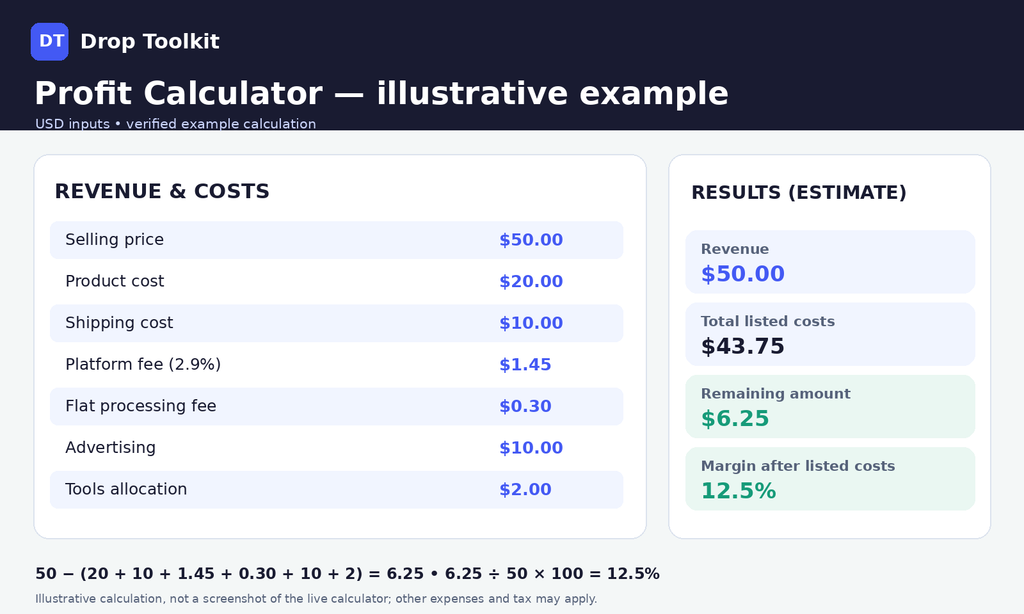
Calculate Your Real Profit With the DropToolKit Profit Calculator
You do not need to estimate profitability in your head.
The DropToolKit Profit Calculator lets you model the economics of a product using figures such as:
- selling price;
- product cost;
- shipping;
- fees;
- advertising;
- other expenses.
This makes it easier to see whether a product still works after realistic costs are included.
Calculate Your Dropshipping Profit
If you are still planning your first store rather than evaluating an individual product, the DropToolKit Startup Cost Estimator can also help you model the wider cost of getting started.
Frequently Asked Questions
What is a good profit margin for dropshipping?
There is no universal percentage that makes a dropshipping product good.
Supplier model, customer acquisition costs, payment fees, returns, operating expenses and pricing power can all change the result.
The important figure is how much remains after the realistic costs required to generate and fulfil the sale.
Is a 20% profit margin good for dropshipping?
It depends on what the 20% represents.
A 20% gross margin may leave very little profit after advertising and payment fees.
A genuine 20% margin after meaningful variable and operating costs represents a very different financial position.
Always identify which costs have already been deducted.
What is the average dropshipping profit margin?
There is no reliable single percentage that applies to every dropshipping business. Published ranges vary substantially by supplier model, product category and business economics. Use these published figures only as reference points.
Is a 30% margin enough for paid ads?
Not necessarily. If customer acquisition consumes the gross margin, little or no profit may remain after payment fees and other expenses.
What is the difference between margin and markup?
Margin compares profit with selling price; markup compares profit with cost. A product costing £80 and selling for £100 has a 25% markup and a 20% gross margin before other expenses.
Can dropshipping be profitable in 2026?
Yes, when realistic supplier, acquisition, shipping, refund, payment and operating costs leave a positive profit. It is not automatic.
Sources
- Shopify — What Is Dropshipping?
- Shopify UK — Is Dropshipping Worth It?
- Shopify UK — Pricing
- Stripe UK — Pricing
- PayPal UK — Merchant Fees
Research and pricing references were reviewed during the October 2026 editorial process. Verify live rates and URLs again before publishing.