
A product can look popular on social media and still be a poor choice for a dropshipping business. Views do not prove purchase intent, a competitor’s advertisement does not reveal its profit, and an attractive supplier price may hide delivery, returns or compliance costs. Dropshipping product validation means examining the evidence before committing money to advertising, stock samples or a launch.
The aim is not to discover a guaranteed ‘winning product’. It is to decide whether the idea deserves a cautious, affordable test. This guide offers a repeatable seven-step process, a five-part scorecard and a hypothetical sterling example. Figures are illustrative rather than market averages.
What does product validation actually prove?
Validation reduces uncertainty; it does not remove it. At minimum, a merchant should ask five separate questions: Is there meaningful customer interest? Are competing offers understandable? Can a supplier reliably fulfil the promise? Does the unit economics model leave enough room for customer acquisition? Are safety, legal and customer-service risks manageable?
A green signal in one area cannot compensate for a critical failure in another. A strong trend does not make an unsafe product acceptable. Likewise, a large theoretical margin means little when a supplier cannot demonstrate realistic delivery times. Record both the evidence and its limitations so a later decision can be reviewed.
Step 1 — Check customer demand, not just social-media views
Begin with a description of the customer problem. Who experiences it, what alternatives do they use and what would make the proposed product preferable? Separate a product category, such as reusable drinkware, from an individual item that has not been evaluated. Keep a written list of customer questions, intended use and seasonal influences.
Google Trends can help compare search-interest patterns by country and period. Its 0–100 index is normalised relative interest, not an absolute monthly search count or a sales forecast. Narrow locations and low-volume terms may show volatile signals. Compare relevant variations, check a longer time period and note whether apparent demand is seasonal. [1]
Search marketplaces for relevant questions and reviews; look for recurring complaints rather than copying competitors’ claims. Record what people praise, what they criticise and what evidence is missing. Consider whether the product solves a durable problem or depends entirely on a short-lived viral moment.
Evidence to save: search term, target country, date range, trend observation, customer questions and two plausible reasons why demand might not convert into purchases.
Step 2 — Analyse competing offers and advertisements
Competition is useful information. Existing sellers may indicate that customers understand the category, but a crowded market can also make profitable acquisition difficult. Inspect the competing product page, total advertised price, delivery promise, differentiating features, guarantees and clarity of returns information.
Meta Ad Library helps investigate adverts associated with advertisers and keywords. TikTok Creative Center Top Ads offers a curated collection of high-performing creatives and filters such as region, industry and campaign objective. An advert being visible—or appearing in a curated collection—does not prove the merchant’s net profit, fulfilment quality or long-term commercial viability. [2] [3]
Instead of copying a video, ask what problem it presents, whether the demonstration is accurate, which audience it addresses and what information is absent. Make a simple competitor table: product claim, price, shipping, evidence, risk and opportunity to offer a clearer customer experience.
Warning: do not reuse another advertiser’s intellectual property, testimonials or claims without permission and substantiation.
Step 3 — Verify the supplier and obtain evidence
A dropshipping supplier is part of the customer experience. Before paying for adverts, ask for specific product dimensions, materials, packaging, shipping origins, shipping methods, dispatch time, tracking availability, fault-handling procedures and supporting compliance documentation where applicable.
Order a sample where practical. Check that the sample matches its listing and that the packaging, instructions and product finish meet expectations. Record the actual dates of dispatch and delivery rather than relying only on estimates. One successful sample is useful evidence but cannot guarantee consistent performance at scale.
Ask what happens if a delivery is late, an item is damaged, an address is wrong or a customer exercises a legitimate return right. Check that the supplier can handle the intended destination country and that any promised local shipping origin is truthful.
Reject or investigate further if the supplier refuses basic product information, cannot explain returns, offers unverifiable compliance claims or makes promises inconsistent with its documented service.
Step 4 — Calculate contribution and maximum affordable CPA
A product idea needs a coherent financial model before an advertising budget is chosen. Start with the selling price, remove expected product costs, shipping, processing fees, refund or replacement allowance and any other relevant per-order costs. Decide explicitly whether tax is included in the prices and costs. Do not mix VAT-inclusive and VAT-exclusive figures without adjustment.
In this simplified model:
Contribution before advertising = net revenue per order − non-advertising variable costs.
Break-even advertising CPA = contribution before advertising − any fixed-cost allocation per order.
This calculation is a planning simplification, not an accounting standard. Fixed costs vary with order volume, so the allocation should be declared. A merchant seeking a profit per order must deduct that target before estimating an acceptable acquisition cost.
For more context, read our guides to dropshipping profit margins, break-even ROAS and pricing dropshipping products.
Worked example: a hypothetical £40 product
Imagine a generic household organiser that is not subject to a separately identified specialist regulatory restriction. This is only a numerical example: no actual supplier, product safety evidence, demand data or advertising outcome is being asserted.
| Assumption | Illustrative value |
|---|---|
| Net revenue per order (VAT treatment already resolved) | £40.00 |
| Product and delivery cost | £16.00 |
| Payment processing and expected returns allowance | £4.00 |
| Contribution before advertising | £20.00 |
| Fixed-cost allocation per order | £2.00 |
| Break-even advertising CPA | £18.00 |
| Desired profit per order | £5.00 |
| Target maximum CPA after desired profit | £13.00 |
The arithmetic is explicit: £40 − £16 − £4 = £20. A £2 allocation reduces mathematical break-even advertising CPA to £18. Reserving another £5 of intended profit yields a £13 target CPA. These are not CPC bids, platform minimums or evidence that the product can obtain sales at £13 per acquisition.
If a hypothetical campaign has a 2% click-to-purchase conversion rate, target break-even-adjusted CPC for a £13 CPA is £13 × 0.02 = £0.26. At 1% conversion, the equivalent would be £0.13. Real conversion rates vary; one test cannot guarantee either assumption.
| Hypothetical conversion rate | Target CPA | Implied maximum CPC |
|---|---|---|
| 1% | £13.00 | £0.13 |
| 2% | £13.00 | £0.26 |
| 3% | £13.00 | £0.39 |
For deeper budget planning, see how much to spend on dropshipping advertising and our startup cost guide. The DropToolKit Ad ROI Calculator can support scenario analysis; its interface uses USD inputs, so convert or substitute values consistently rather than entering pounds as though they were dollars.
Step 5 — Screen product safety, returns and advertising claims
Product selection is also a compliance decision. UK business guidance says those making, importing, distributing or selling consumer products have responsibilities for product safety and applicable labelling. Requirements depend on product, jurisdiction and supply chain; a supplier screenshot alone is not proof of compliance. Obtain relevant evidence and professional advice when needed. [4]
For many UK consumer distance sales, customers have a 14-day cancellation period after receipt of goods, with statutory exceptions and additional rules. Plan for legitimate refunds and returns rather than promising ‘no returns’. Describe delivery times, complete prices, product characteristics and trader information accurately. [5] [6]
Advertising platforms can also reject misleading listings. Google Merchant Center’s misrepresentation policy addresses hidden delivery conditions, misleading stock or origin claims and inaccurate business information. [7] Never advertise an unverified medical effect, safety certification or brand affiliation. Do not assume the dropshipping model transfers the retailer’s legal responsibilities to a supplier.
A potential legal or safety failure is a hard stop regardless of the idea’s other scores. Avoid high-risk categories until all applicable requirements can be established reliably.
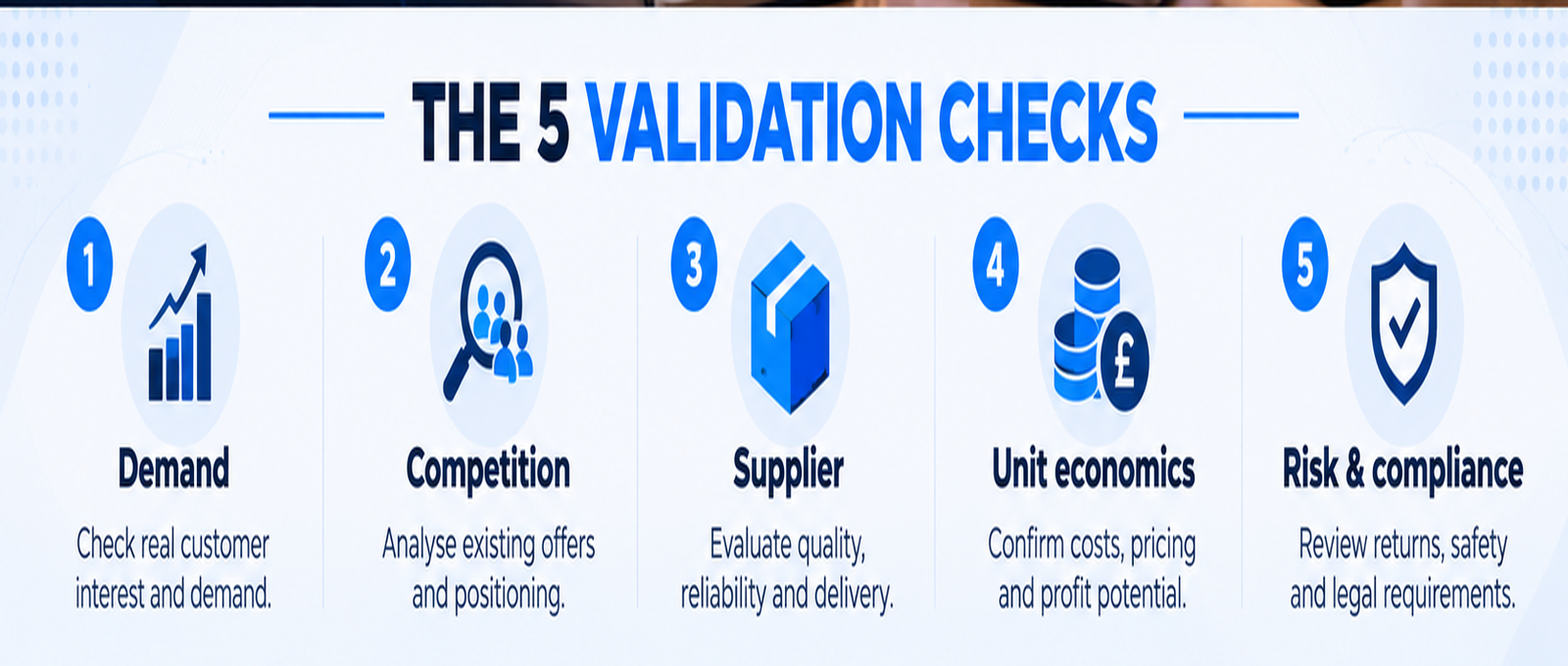
Step 6 — Complete a five-part product validation scorecard
Use this scorecard as an internal evidence organiser. Each area receives 0 for no credible evidence, 1 for incomplete evidence or 2 for satisfactory evidence. It is not a scientifically validated predictive model; a total is not a probability of success.
| Check | Score 0 | Score 1 | Score 2 |
|---|---|---|---|
| Demand | No meaningful evidence | Some relevant signals | Multiple consistent signals |
| Competition | Unknown offers or economics | Partial competitor analysis | Documented positioning and price comparison |
| Supplier | Unverified fulfilment | Some supplier evidence | Sample and fulfilment checks completed |
| Unit economics | Costs unknown or infeasible | Partial cost model | Documented viable assumptions and sensitivity |
| Risk and compliance | Critical unresolved concerns | Further evidence required | Applicable checks reasonably documented |
For a hypothetical organiser, suppose the recorded scores were demand 2, competition 1, supplier 1, economics 2 and risk 1. The total is 7/10, but the supplier and compliance gaps still require investigation. There is no automatic pass threshold. A serious safety or legal issue overrides a high total.
Record the source URL or document, date, decision-maker, finding and unresolved question for every score. Treat ‘no evidence’ as a reason to gather evidence, not as evidence that the product is necessarily bad.
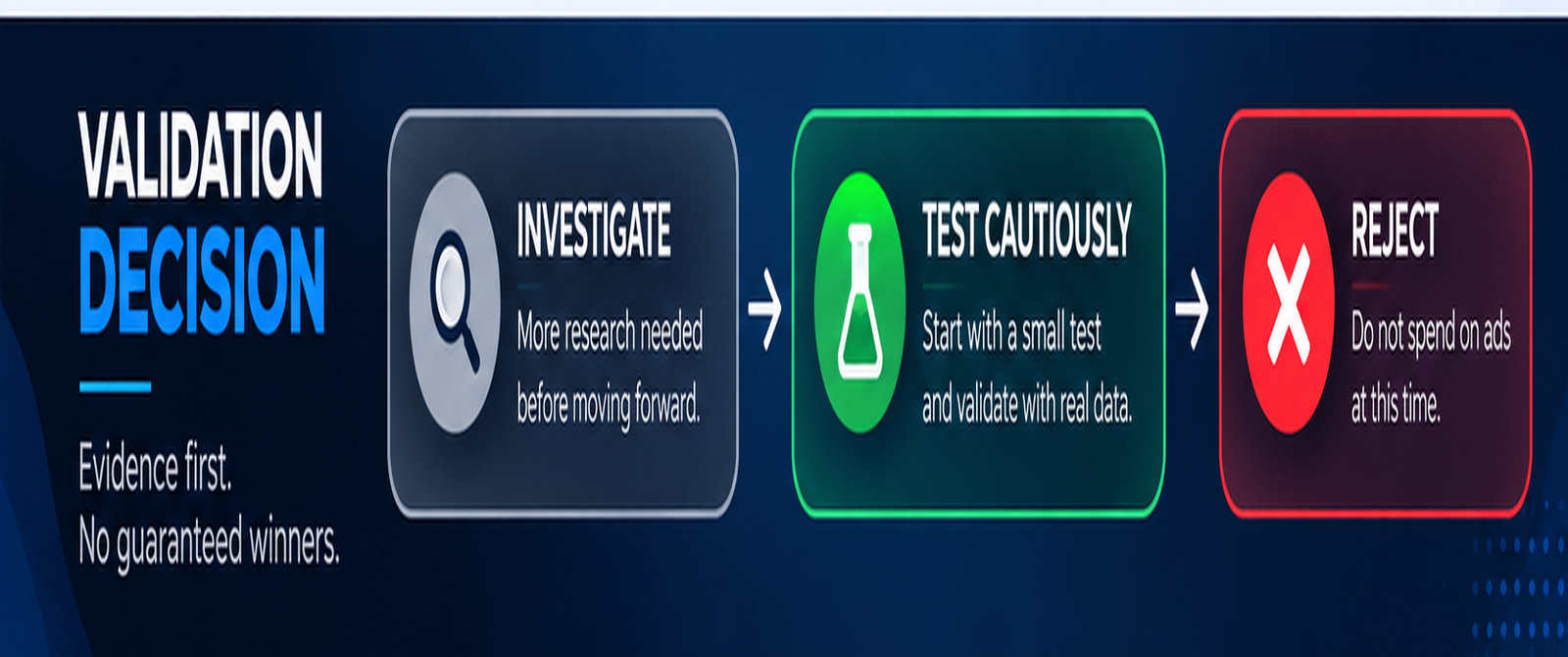
Step 7 — Choose investigate, cautious test or reject
Investigate: the product has some potential, but missing evidence could materially change the decision. Verify supplier quality, delivery, compliance or customer demand before spending on ads.
Test cautiously: no critical risks remain, the financial model is coherent and a limited advertising test is affordable. Define the total spend cap, metrics, observation window and stop conditions beforehand. Watch both purchase data and operational signals such as complaints or late delivery. A small sample creates uncertainty; do not treat a handful of sales as definitive proof of long-term profitability.
Reject or postpone: a critical legal or safety issue is unresolved; supplier promises appear unreliable; costs make the advertised price unrealistic; or the owner cannot afford to lose the proposed test budget. ‘Reject’ describes the current evidence, not an eternal verdict on a product category.
Common mistakes when validating dropshipping products
Assuming a viral product is a winning product
High view counts measure attention in a particular context. They say little about refunds, acquisition costs, genuine purchase intent or fulfilment. Demand research should use multiple types of evidence.
Confusing revenue with profit
A £40 sale does not equal £40 available for adverts. Include fulfilment, fees, returns and the profit you wish to retain. Inspect margins and break-even limits before choosing spending levels.
Ignoring the customer after checkout
Delivery delays, unclear return procedures and unsatisfactory goods damage trust. Supplier validation is not a one-off check: monitor the service after any launch.
Treating a scorecard as a guarantee
A 9/10 score does not cancel an unresolved electrical-safety question. A scorecard makes assumptions visible; it does not verify them for you.
Testing without a stop condition
Set a spending cap and a review plan you can sustain. Do not increase a budget merely to ‘recover’ previous losses. Poor data quality is a reason to investigate, not automatically to spend more.
Frequently asked questions
Can I validate a dropshipping product for free?
You can perform initial desk research with publicly accessible search trends, adverts and competitor pages. Physical samples, expert reviews, business checks and paid experiments may still cost money. Free information should not be confused with complete verification.
How many competitors should I analyse?
There is no universal number. Select relevant competitors serving the same target customer and market, compare consistent attributes and continue until major differences and unknowns are clear. More screenshots do not automatically improve the quality of the analysis.
Does Google Trends prove demand?
No. It reports relative search interest from sampled queries, normalised by location and time. Use it alongside customer questions, competitor offers and actual commercial evidence. [1]
Should I order a sample before running ads?
A sample is generally a sensible way to check the physical product and delivery experience. It does not replace legal checks or guarantee future batches, but marketing claims should not go beyond what can be substantiated.
What score is good enough to start advertising?
There is no validated numerical threshold. Clear all critical safety, legal and supplier risks first, confirm that the finances are plausible, and only then consider a limited test whose potential loss is affordable.
Conclusion: evidence first, advertising second
Product validation is a structured decision, not a treasure hunt for a guaranteed winner. Research the customer problem, verify competing offers and supplier capability, model contribution after realistic costs and document legal risks. Use the scorecard to highlight uncertainty rather than hide it. Then decide whether to investigate more, run a cautious test or walk away.
If the idea passes those checks, use our advertising budget guide to define the next experiment without assuming that a particular platform, product or budget guarantees sales.
References
- Google Trends Help — FAQ about Google Trends data. Normalisation and sampling.
- Meta — Ad Library. Advert discovery and transparency.
- TikTok for Business — How to use Top Ads Dashboard. Creative research filters and selection.
- GOV.UK — Product safety advice for businesses. Safety and labelling responsibilities.
- GOV.UK — Accepting returns and giving refunds. UK distance-selling returns guidance.
- GOV.UK — Online and distance selling. Trader information and cancellation obligations.
- Google Merchant Center Help — Misrepresentation. Advertising and shopping-listing transparency.