
A £150 advertising test may be affordable for one dropshipping business and completely unsuitable for another. The right starting budget is not a number copied from a forum: it is an amount you can afford to lose while still learning something useful about a product, offer and audience.
This guide explains how to connect advertising spend to break-even CPA, expected clicks, conversion rate and the contribution remaining from each order. It uses a transparent £50 order example rather than claiming that a particular platform or budget guarantees sales.
Important: All figures are illustrations in GBP, using a VAT-exclusive model. The 2027 date is a planning horizon, not a forecast of 2027 advertising prices. Platform rules quoted here were checked in October 2026 and should be rechecked before launching a future campaign. This is educational material, not financial, tax or advertising advice.
There is no universal beginner dropshipping ad budget
A beginner often asks whether £50, £150 or £500 is enough to test a product. But the same spend can buy very different numbers of clicks across placements, markets and periods. It can also produce very different financial outcomes if shipping, refunds or payment fees change.
A sensible test budget depends on three separate questions: how much cash can the business lose without harming essential obligations; how much acquisition cost the order economics can support; and whether the selected ad platform allows the intended campaign setup.
- Affordability: set a test-loss ceiling in advance; never use rent, tax or essential operating funds.
- Unit economics: calculate the most you can pay to acquire one order under an explicitly stated model.
- Measurement: decide which clicks, conversions, fees and dates will be recorded before spending.
- Delivery constraints: verify platform-level minimum budgets and how daily or lifetime budgets work.
Start with your allowable cost per order
We reuse the VAT-exclusive economics from our break-even ROAS guide. A £50 order with £32.25 of non-ad variable costs and a £2 illustrative fixed-cost allocation leaves £15.75 for acquiring the order at mathematical break-even. No £2 profit target is included here.
| Order economics | Illustrative amount | Meaning |
|---|---|---|
| Revenue per attributed order | £50.00 | VAT-exclusive order value |
| Product, shipping, payment and refund allowance | −£32.25 | Assumed non-ad variable costs |
| Fixed-cost planning allocation | −£2.00 | Illustrative share per order |
| Allowable break-even CPA | £15.75 | Maximum advertising cost per order in this model |
Allowable break-even CPA = revenue − non-ad variable costs − fixed-cost allocation − desired profit. At mathematical break-even the desired-profit term is zero. For an actual profit target, deduct that target as well.
This does not mean every campaign with £15.75 CPA is safe. Unmeasured returns, tracking differences, taxes, attribution delay and unallocated costs may push the real result below break-even. A prudent target would normally leave a buffer above the mathematical zero-profit line.
Estimate the clicks your budget may buy
For a click-priced illustration, expected clicks equal test budget divided by average CPC. Expected orders equal clicks multiplied by the click-to-order conversion rate expressed as a decimal. These are scenario calculations, not performance forecasts.
Estimated clicks = planned spend ÷ assumed average CPC.
Modelled orders = estimated clicks × assumed conversion rate.
Modelled CPA = planned spend ÷ modelled orders, provided modelled orders are above zero.
Worked example: a hypothetical £150 test
| Input | Assumption |
|---|---|
| Maximum planned test spend | £150.00 |
| Average CPC | £0.75 |
| Click-to-order conversion rate | 3% |
| Revenue per order | £50.00 |
| Contribution per order after non-ad costs and allocation | £15.75 |
The arithmetic gives 200 estimated clicks (£150 ÷ £0.75), six modelled orders (200 × 0.03) and £25 modelled CPA (£150 ÷ 6). Six orders would leave £94.50 of contribution before ads (6 × £15.75). After £150 of ad spend, the modelled result is −£55.50.
This is not a guaranteed or even a likely outcome. Six orders is merely the expected count implied by fixed assumptions. An actual £150 test could produce no orders, more orders or a different average CPC. Platform attribution may also count conversions on a different timetable from financial records.
What happens when conversion rate changes?
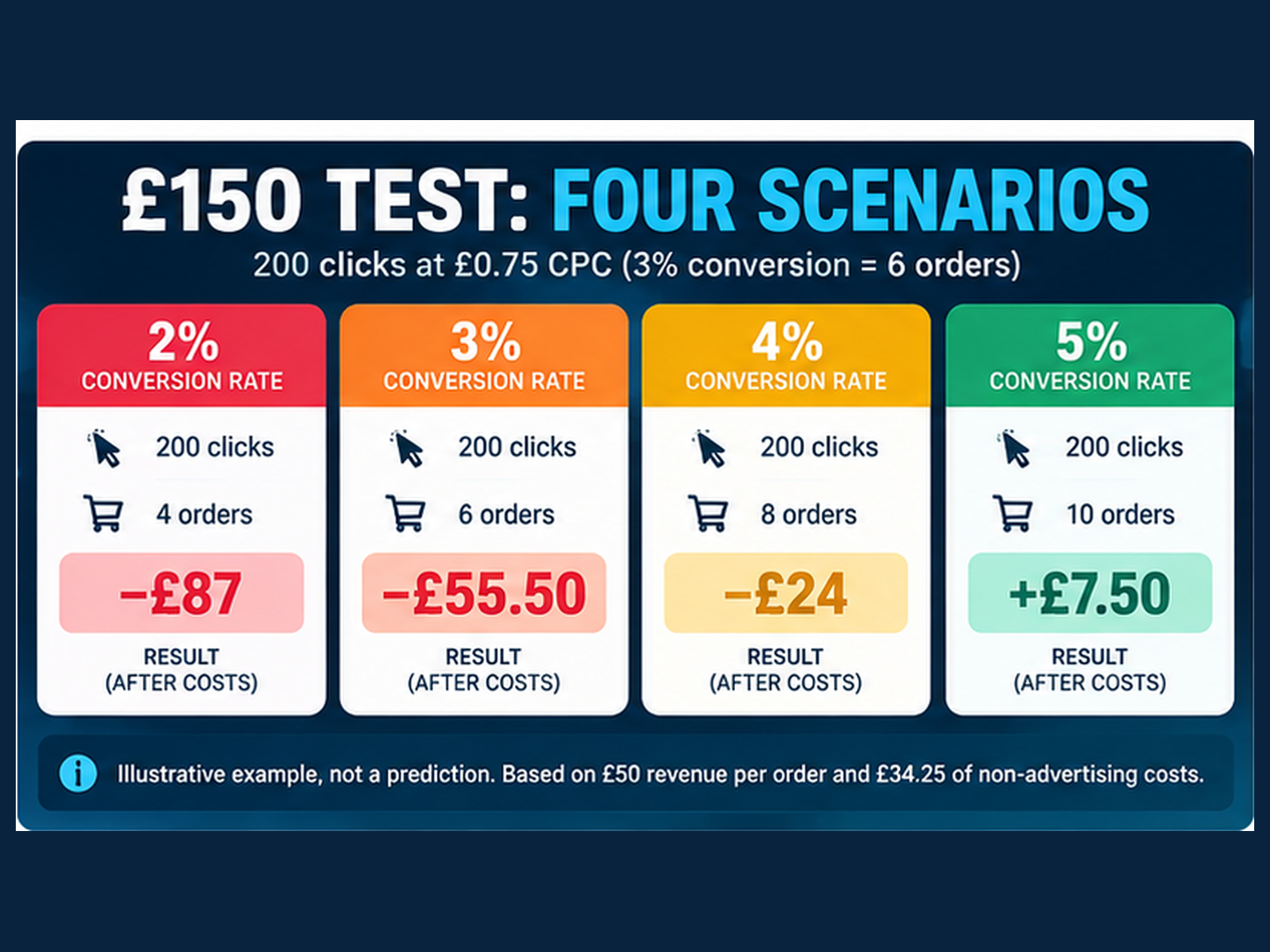
Hold spend at £150, CPC at £0.75 and estimated clicks at 200. If the observed rate changes, so do the orders and the financial outcome. The table below assumes whole numbers of orders at these particular rates and a constant £15.75 contribution per order.
| Conversion rate | Modelled orders | Modelled CPA | Result after ads |
|---|---|---|---|
| 2% | 4 | £37.50 | −£87.00 |
| 3% | 6 | £25.00 | −£55.50 |
| 4% | 8 | £18.75 | −£24.00 |
| 5% | 10 | £15.00 | +£7.50 |
At the displayed values, ten whole orders are required to cover £150 of spend because £150 ÷ £15.75 = 9.5238…. Ten orders from 200 clicks would imply a 5% conversion rate. This is an arithmetic threshold, not a prediction that a 5% rate can be achieved.
Calculate the maximum break-even cost per click
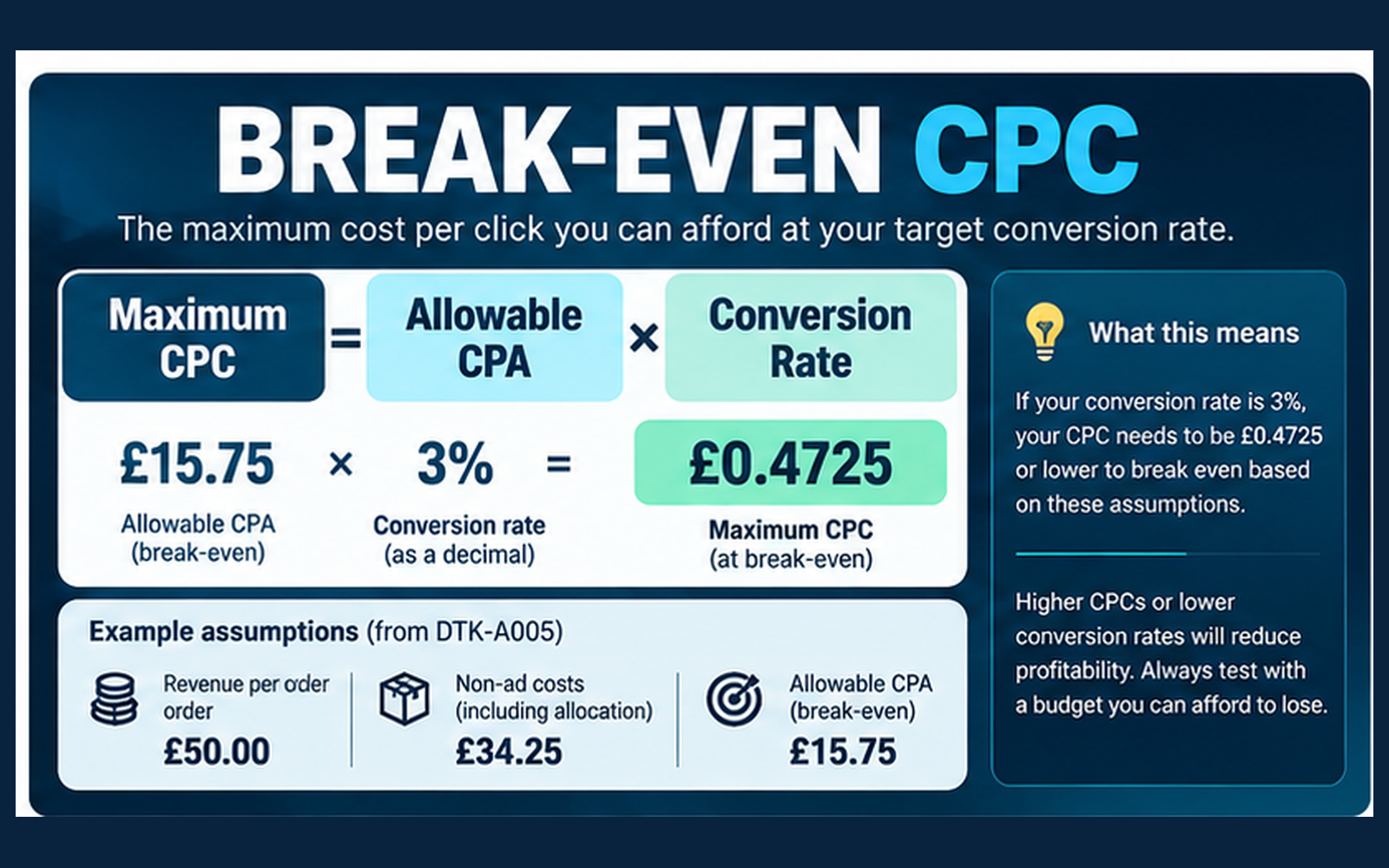
You can also work backwards from your order economics. If you assume the same click-to-order conversion rate throughout, maximum break-even CPC = allowable break-even CPA × conversion rate.
At 3% conversion and £15.75 allowable CPA: £15.75 × 0.03 = £0.4725 per click. The hypothetical CPC of £0.75 is therefore above that threshold; it would require stronger conversion, better economics or a lower acquisition cost to break even.
Do not confuse this calculation with a guaranteed bid. Actual auction prices vary, and automated bidding, attribution and delayed purchase decisions can produce results outside the simplified click-to-order model.
A test budget is not the same as a platform budget setting
Your business test cap is a decision about total risk. The platform budget is a delivery setting. These must be reconciled before launching, especially where campaigns share budgets or where spend can vary between days.
Google Ads: daily budgets are averages
Google Ads explains that for most campaigns a day may spend as much as twice the average daily budget, with a monthly limit usually calculated as 30.4 times the daily average. Exceptions and changes during the month matter. A £10 average daily budget is therefore not necessarily a strict £10 spending cap on every day.12
If your total loss tolerance is tightly limited, review the campaign budget report, account controls, dates and current Google documentation rather than treating a daily average as an exact daily stop-loss.
TikTok Ads: minimums may rule out a small test
TikTok documentation last updated in July 2026 lists campaign-level budgets exceeding US$50 and ad-group daily budgets exceeding US$20, with additional rules for lifetime budgets. These are stated in USD; do not treat a GBP illustration as the platform minimum or assume currency parity.3
Its broader budget guidance also distinguishes operational minimums from suggested levels needed for particular optimisation objectives. A technically valid small budget may still provide very little performance evidence.4
Meta Ads: check the current interface
Meta advertising also offers budget and delivery controls, but their availability and minimums can depend on the campaign setup. We do not give a universal Meta minimum here because one authoritative, currently applicable minimum was not independently established for every objective. Inspect the live Ads Manager controls and current documentation before committing funds.
Build a decision rule before launching
A useful test is designed around a written decision rule, not only a total spend figure. “Stop-loss” in this article means a personal review-and-pause policy; it is not a claim that every platform provides an identical hard-stop setting.
- Set the maximum cash loss you can afford, separately from the amount you hope to spend.
- Write down the assumed revenue, contribution, CPC, conversion rate and allowable CPA.
- Choose a defined observation window and recognise that conversions can arrive late.
- Check platform delivery limits, billing exposure and whether campaigns may spend unevenly.
- Record actual spend and conversions, then compare them on a consistent reporting and refund basis.
- Pause or reassess when your predetermined risk limit or evidence-review point is reached; do not chase losses simply because a test has already cost money.
A tiny sample cannot establish a reliable long-run conversion rate. For example, going from four orders to six orders out of 200 clicks changes the observed rate from 2% to 3%, but does not prove that one ad, product or audience is intrinsically better. Changes in traffic mix and measurement may explain part of the difference.
How to use the DropToolKit Ad ROI Calculator
The DropToolKit Ad ROI Calculator allows you to examine campaign spend, clicks, conversions, average order value, product-plus-shipping costs, percentage fees and flat fees. It can report ROAS, CPA and modelled financial outcomes.5
The calculator currently uses USD input fields and provides an approximate GBP view. Our £150 example is in GBP. Do not paste £150 into a field labelled USD and describe the result as a GBP calculation. Instead, use a separately labelled all-USD illustration, or convert every relevant monetary input consistently using an explicitly documented exchange rate and date. The calculator is a planning aid, not an accounting system.
It also does not offer dedicated fields for all possible refund losses and fixed-cost allocations. If you represent these assumptions through other inputs, document the adjustments clearly and do not count costs twice.
Five common dropshipping ad-budget mistakes
Copying someone else’s daily spend
A budget that is sustainable for a business with strong margins can be unaffordable for a beginner with limited cash and uncertain returns. Start with your risk tolerance and economics.
Ignoring non-ad costs
Revenue-based ROAS can look attractive while shipping, products, payment fees and refunds absorb the contribution. Read our profit margins guide before setting a campaign target.
Mistaking a budget for a price guarantee
An advertising platform can spend the budget without producing purchases. A £150 campaign cap is not a promise of six sales or of £300 in revenue.
Reading small samples as certainty
Early data is noisy. Compare the same conversion definition, attribution window and cost basis, and avoid overstating findings from a handful of orders.
Using a profitable selling price but unaffordable acquisition
A price that looks viable before advertising may fail once traffic costs rise. See our pricing guide, and use the beginner start-up cost guide to keep ad tests separate from broader business expenses.
Frequently asked questions
Is £150 enough to test a dropshipping product?
It may be enough to run a small learning exercise on some setups, but not necessarily to produce a meaningful number of conversions or satisfy every platform’s budget minimum. Check your cash limit, campaign eligibility and the questions the test must answer.
Should beginners use daily or lifetime budgets?
Neither is universally preferable. Daily settings can help ongoing oversight, while lifetime settings can suit fixed campaign windows. Review the platform’s exact delivery rules and minimums; budget pacing is not identical across services.
What if I spend money but get no orders?
A zero-order test has no finite observed CPA. Review the landing page, offer, tracking, traffic quality and spend limit. Avoid declaring a stable conversion rate or blindly increasing the budget.
What CPA should a dropshipping beginner target?
Calculate it from actual order contribution and a profit objective. The £15.75 break-even CPA here is illustrative for a particular £50 order, not a market benchmark.
Can ROAS be positive while profit is negative?
Yes. ROAS compares tracked conversion value with advertising spend, not all business costs. A campaign can record sales and still lose money after fulfilment, fees and overhead. Our break-even ROAS guide explains the distinction.
Conclusion
A useful dropshipping advertising budget is one you can afford to lose, understand and evaluate. Begin with contribution per order, translate that into a break-even CPA and CPC, estimate what a test might buy under clearly labelled assumptions, and choose a review rule before activating any campaign.
The £150 example shows that 200 hypothetical clicks and six orders would not cover £150 of advertising under the stated £15.75 per-order contribution. The goal is not to promise a particular outcome; it is to make the trade-offs visible so you can make a better decision with actual data.
Source notes
- Google Ads Help, About average daily budgets. Reviewed 24 October 2026. https://support.google.com/google-ads/answer/6385083?hl=en-GB.
- Google Ads Help, About spending limits. Reviewed 24 October 2026. https://support.google.com/google-ads/answer/10486637?hl=en-GB.
- TikTok Ads Manager, About budgets for ads. Reviewed 24 October 2026. https://ads.tiktok.com/resources/help/article/budget.
- TikTok Ads Manager, Tips to select your budget. Reviewed 24 October 2026. https://ads.tiktok.com/resources/help/article/budget-best-practices?lang=en.
- DropToolKit, Ad ROI Calculator. Reviewed 24 October 2026. https://droptoolkit.com/tools/ad-roi-calculator.html.