
Returns and refunds are not somebody else’s problem simply because a supplier dispatched the parcel. If your dropshipping business is the consumer-facing retailer, it needs a clear process for cancellation, faulty goods, reverse logistics and refunds. A policy should comply with applicable UK law and be workable with the supplier’s actual arrangements.
This guide distinguishes eligible online change-of-mind cancellations from statutory rights concerning faulty goods. It also explains how to track return-related costs. All pound-sterling figures are hypothetical examples, not supplier quotations. Legal rules were reviewed in October 2026; confirm the current position before publishing a 2027 policy.
Two different reasons for a return
A customer might simply change their mind about an eligible online order, or report an item that is faulty, not as described or otherwise fails to conform to the contract. These situations have different legal routes. Do not apply a single blanket deadline or return-postage rule to both. [1][2][3]
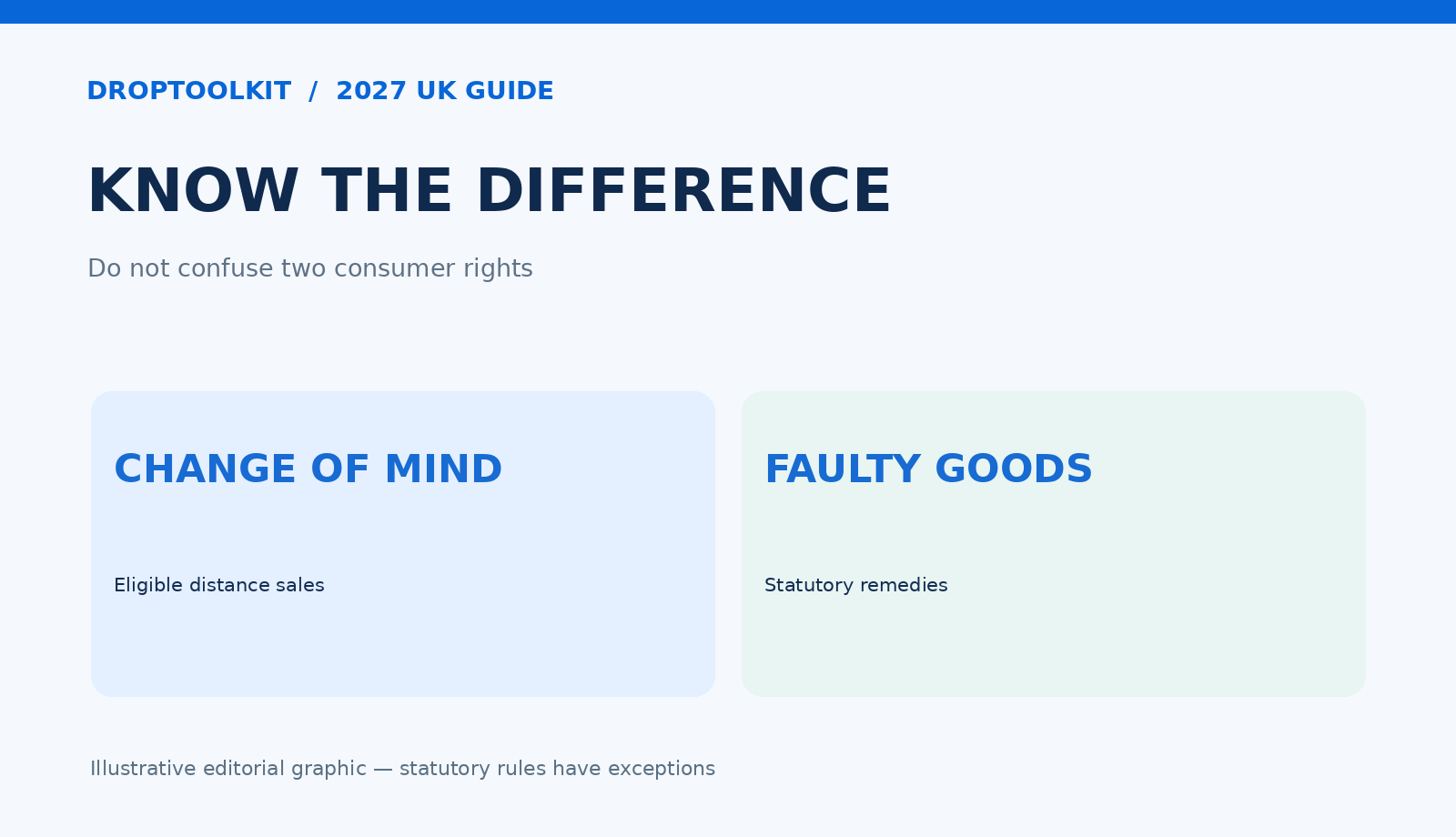
| Situation | Typical right | Seller action |
|---|---|---|
| Eligible online change of mind | Distance-selling cancellation | Explain cancellation and return arrangements |
| Faulty or misdescribed goods | Consumer Rights Act remedies | Assess rejection, repair or replacement as appropriate |
| Potential exemption | Check the specific cancellation exception | Confirm whether faulty-goods rights still apply |
How the 14-day online cancellation right works
For many consumer distance purchases, the buyer normally has 14 days from delivery to tell the retailer that they wish to cancel, without giving a reason. They normally have another 14 days to return the goods. Particular exceptions and alternative start dates can apply. The consumer must receive clear cancellation information before purchase. [1][2]
The trader generally refunds the goods price and standard outbound delivery, but not the extra price of an optional premium delivery service. The refund timing rules may allow the trader to wait for the goods back or evidence they were sent. The customer may have to cover direct return postage for a change-of-mind cancellation when the required information was provided. Do not silently impose fees or obscure the cancellation route. [1][2]
Check exceptions instead of inventing them
Certain personalised, perishable and other specified products may be exempt from the ordinary change-of-mind cancellation right. A supplier’s “no returns” notice, a discounted price or the fact that fulfilment is outsourced does not itself create an exemption. Rights about faulty goods are assessed separately. [1][2]
Faulty goods and the 30-day short-term right to reject
The Consumer Rights Act 2015 provides a short-term right to reject goods that do not meet statutory requirements. The usual period is 30 days, measured under specific statutory rules rather than simply from the payment date. Some goods and repair or replacement situations require different calculations. Other remedies can remain available after that period. [3][4]
This is not a general 30-day change-of-mind guarantee. On valid statutory rejection the trader generally bears reasonable costs of returning the goods, subject to the legislation’s terms. The retailer must not refer consumers exclusively to an overseas supplier when that would sidestep consumer-facing obligations. [4]
| Question | Change-of-mind cancellation | Faulty-goods remedy |
|---|---|---|
| Reason | Often no reason for eligible distance purchase | Goods fail legal or contractual standards |
| Typical initial period | Usually 14 days to notify after delivery | Short-term rejection generally 30 days |
| Original delivery | Normally standard outward delivery refunded | Depends on the remedy and governing rules |
| Return postage | Consumer may pay if properly informed | Trader generally bears reasonable costs for valid rejection |
Who receives the returned parcel?
Before listing products, confirm the returns address, who issues a label, whether an overseas shipment is required, who pays transport and who inspects defects. Do not offer an unverified UK returns address. A supplier may provide commercial refunds or replacements, but that agreement does not replace the retailer’s duties towards the customer.
Use the supplier evaluation checklist to check the returns workflow alongside stock, shipping and product quality. Verify the process using a real sample rather than a marketing promise.
Five steps for handling a return
1. Record and classify the request
Keep the order number, dates, product, customer request and relevant evidence. Identify whether it is a cancellation, fault, delivery dispute or another issue before choosing a remedy.
2. Respond clearly
Acknowledge the request, explain practical next steps and use a contact channel the customer can actually access. Keep communication factual and courteous.
3. Confirm the return route
Get supplier authorisation if useful, but do not allow an internal approval queue to override legal timeframes. Explain where goods should go, how tracking works and whether a label is provided.
4. Calculate and process the appropriate refund
Separate goods value, standard outward delivery, premium delivery, authorised deductions and return-postage responsibility. Rules differ between lawful cancellation and remedies for non-conforming goods. [1][4]
5. Close the case and monitor the pattern
Retain an audit trail of the decision, tracking, refund and supplier credit. Frequent claims may indicate poor sizing information, dispatch damage or misleading descriptions.
Model the real cost of returns
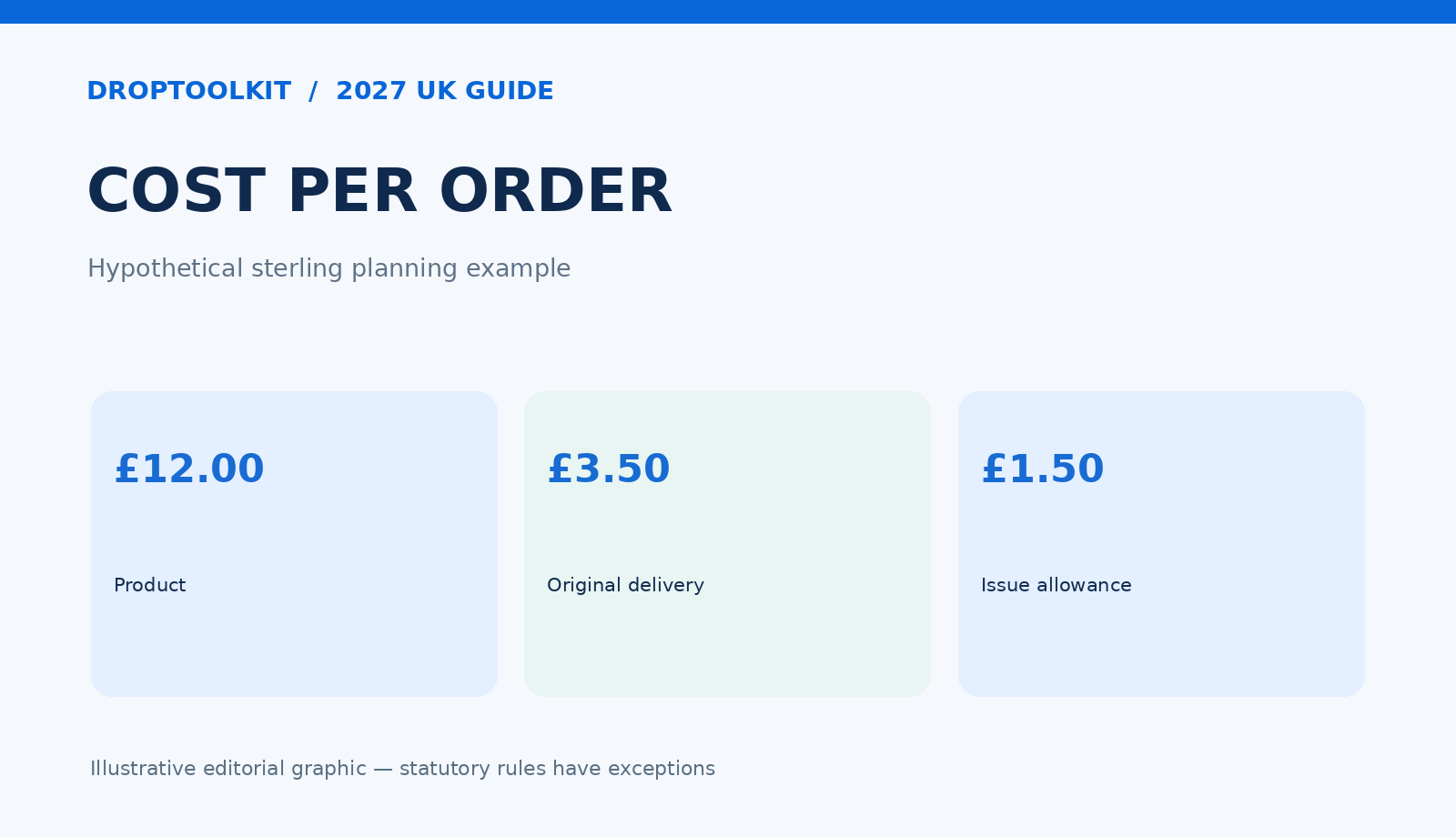
Even a business that receives few returns can spend money on replacement parcels, postage, support, payment fees and unrecoverable stock. Use an evidence-based expected issue allowance in the margin model, and review it as order history grows.
| Illustrative cost per order | Amount |
|---|---|
| Product cost | £12.00 |
| Original delivery | £3.50 |
| Expected issue allowance | £1.50 |
| Modelled total | £17.00 |
This fictional calculation is £12.00 + £3.50 + £1.50 = £17.00. At a fictional selling price of £32.00, £32.00 − £17.00 = £15.00 remains before advertising, card fees, platform costs, applicable taxes and other expenses. It is not net profit, and the £1.50 allowance is an assumption rather than an observed return rate.
For a wider model, refer to the profit margins guide, pricing guide and advertising budget guide.
What to include in a UK returns policy
Explain the business’s identity and contact details, cancellation eligibility and procedure, the actual return address or process, who pays direct return costs, statutory rights relating to faulty goods, likely refund methods and timing, and any genuine exceptions. Match the policy to checkout disclosures, customer emails and supplier arrangements. [1][2]
Shipping promises also affect complaints and cancellations. Read the shipping times and costs guide before drafting delivery and returns wording.
Common mistakes
Using “no refunds” as a blanket rule. Business terms cannot remove consumer statutory rights. [1]
Combining every deadline. The online 14-day cancellation framework and the statutory faulty-goods rights are different.
Passing every complaint to the supplier. The seller named in the consumer contract must understand its own obligations.
Ignoring the cost of reverse logistics. Lost parcels, labels and replacements can erase a small margin.
Promising an untested return address. Confirm it can actually accept parcels.
Frequently asked questions
Can a UK dropshipping shop refuse all returns?
No. There are limited exceptions to change-of-mind cancellation, but a blanket refusal cannot remove relevant statutory rights about faulty goods. [1][2]
Does every online buyer have 30 days to change their mind?
No. The usual distance-selling cancellation framework and the short-term right to reject non-conforming goods have different purposes and conditions. [1][3]
Who pays if a product arrives faulty?
On a valid rejection under the relevant statutory provisions, the trader generally bears reasonable return costs, subject to the law’s terms. [4]
Can my supplier refund my business separately?
Yes, the commercial contract may provide a credit or replacement, but your customer’s rights should be handled independently of whether that supplier has already reimbursed you.
Is a returns portal essential?
Not necessarily. A portal can make operations more efficient, but consumers still need an accessible and lawful route to raise issues and exercise rights.
Final returns checklist
Before launching, confirm who sells to the consumer, keep accurate return and cancellation terms, test the real supplier address and claims process, budget for faults and carriage, and save case records. Recheck official guidance and legislation when the 2027 article is reviewed for publication.