
A customer reporting a missing parcel or an unexpected card payment can trigger more than a normal refund request. A payment dispute may temporarily reverse a sale, attract processor fees and require evidence before a deadline. For a UK-focused dropshipping business, the safest approach is to make accurate delivery promises, keep a clear order record and respond to each complaint before it escalates.
This guide explains how chargebacks work, how they differ from ordinary returns and Section 75 claims, which records matter and how to model the financial exposure. It is general educational information, not legal, tax or payment-provider advice. Card-network and processor rules change; verify the current requirements in your own account before acting.
What is a chargeback in dropshipping?
A chargeback is a card-scheme process in which a card issuer may seek to reverse a disputed transaction through the merchant’s acquiring or payment-processing arrangements. A customer might dispute a transaction because goods did not arrive, the amount was wrong, the payment was unauthorised or a refund was not processed. A chargeback is not a statutory right to a refund, and a dispute is not automatically proof that the merchant acted wrongly. [1][2]
As a seller, your provider normally notifies you of a dispute and its reason code. The provider may debit the disputed amount, charge a fee or hold funds under its terms. You must use the actual provider deadline, not a generic internet timeframe. [4]
Chargeback, retailer refund and Section 75: three different routes
| Route | Who starts it? | Main distinction |
|---|---|---|
| Retailer refund | Customer contacts the shop | The seller assesses and resolves the request under the contract and consumer law. |
| Chargeback | Cardholder contacts their issuer | Card-scheme process; issuer, acquirer and provider rules govern evidence and time limits. |
| Section 75 claim | Eligible credit-card customer contacts lender | Separate statutory protection under the Consumer Credit Act 1974 when requirements are met. |
Section 75 can apply to qualifying credit-card purchases with a cash price over £100 and up to £30,000, subject to conditions and exceptions. It is not the same as a chargeback and should not be promised for every payment method. UK Finance and MoneyHelper explain the distinctions. [1][2]
Common reasons for payment disputes
The most relevant risk for many dropshipping shops is goods not received: slow processing, an inaccurate promised date or a tracking number that never reaches a delivery scan. Other reasons include goods not as described, duplicate billing, a failed refund, or an allegedly unauthorised transaction. The dispute reason determines which evidence may be useful. [4][5]
Do not assume that a tracking number alone wins a non-receipt dispute. Evidence of carrier acceptance, destination and delivery may be more persuasive, but admissibility and outcome depend on the network rules, dispute category and circumstances.
How to handle a chargeback: a practical workflow
Begin by reading the notification in your provider’s dashboard. Record the reason code, amount, deadline and whether the case is a preliminary enquiry or an actual dispute. Check the order record, payment, correspondence, shipping history, delivery destination and any refund already issued.
If the claim is valid or evidence is weak, accepting the dispute may be more appropriate than challenging it. If you have relevant evidence and a defensible position, prepare a concise factual response using the provider’s supported workflow. Stripe notes that evidence must be submitted within the assigned timeline and that there may be only one submission opportunity. [4]
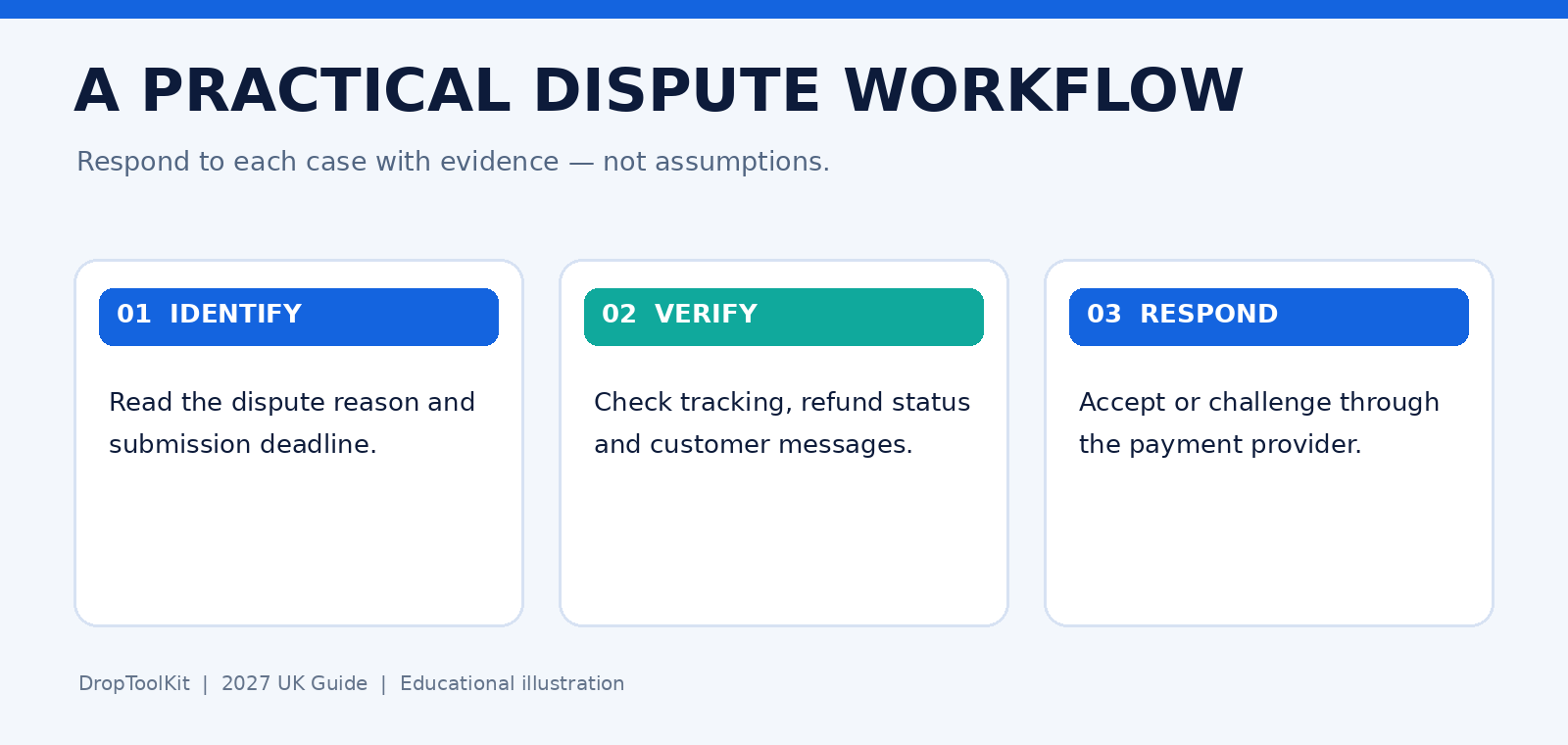
| Stage | Action | Evidence to retain |
|---|---|---|
| Notification | Log reason code, amount and response deadline | Provider alert and transaction ID |
| Investigation | Compare payment, customer promise and shipping events | Order confirmation, policy version, tracking |
| Decision | Accept or challenge on the merits | Refund record or evidence submission |
| Outcome | Record costs and review preventable causes | Final decision and reconciliation |
Which documents should a dropshipping merchant keep?
Build a dated folder for each order that includes the product description at purchase, checkout total, delivery estimate, terms accepted, invoice, supplier fulfilment records, tracking scans and customer-service messages. Where applicable, include refund confirmations and photographs relevant to a product-quality dispute. Do not retain more payment or personal data than is necessary; use the payment provider’s secure workflow for sensitive evidence. [3][5]
Evidence should be legible, factual and tailored to the dispute reason. A screenshot of a shipping label is different from proof of delivery. Never manufacture a delivery record, edit customer correspondence or submit irrelevant personal information.
Who is responsible when a supplier fails to deliver?
If your business is the consumer-facing retailer, a private agreement with the supplier does not automatically remove your obligations to the customer. Review the relevant contract, consumer rights and delivery commitments. Record your supplier reimbursement separately from your customer refund or card dispute; they are not interchangeable transactions.
To reduce exposure before choosing a supplier, use our reliable supplier checklist, shipping times and costs guide and returns and refunds guide.
Financial example: how a dispute affects a sale
Consider a fictional order with a customer payment of £40.00, combined product and fulfilment costs of £19.00 and an assumed dispute fee of £15.00. These are scenario inputs, not live provider prices. Fees, fee refunds and fund movements vary by provider, region and outcome. [4]
| Item | Illustrative amount | Treatment |
|---|---|---|
| Customer payment | £40.00 | Originally collected |
| Product and fulfilment | £19.00 | Assumed cost already incurred |
| Disputed payment reversal | £40.00 | Assume the £40 is ultimately lost |
| Assumed dispute fee | £15.00 | Illustrative processor charge |
| Illustrative net impact | −£34.00 | £40 − £40 − £19 − £15 |
Under the stated lost-dispute scenario, the seller receives £40, loses £40 through the reversal, has already paid £19 in goods and fulfilment and pays an assumed £15 fee. The net result is −£34 before other operating expenses or taxes. The original £40 is not subtracted twice: the first £40 represents receipt, and the second its reversal. If the funds were never settled, the accounting presentation differs but the same assumed economic loss remains.
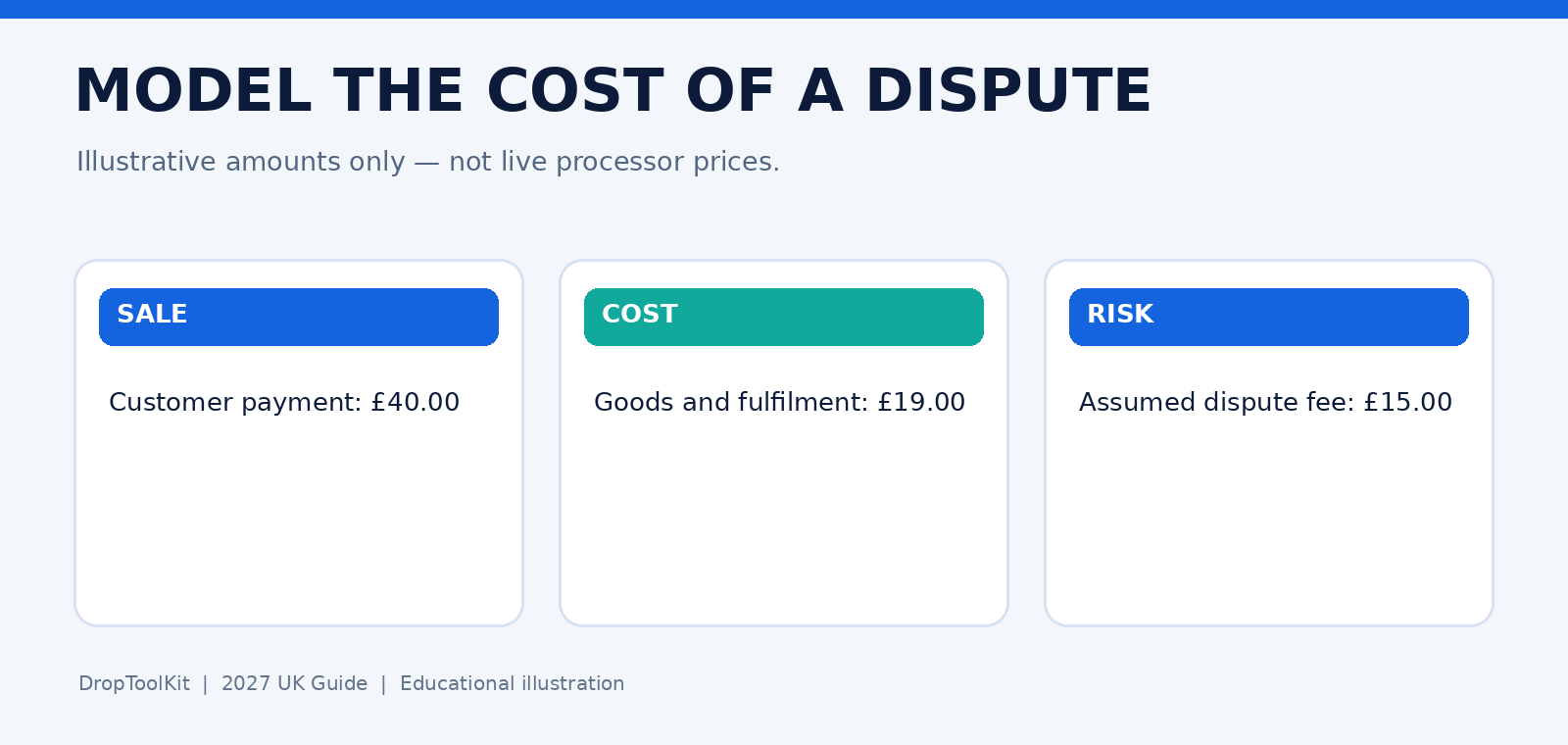
Compare this with an undisputed order: £40 − £19 = £21 contribution before advertising, payment-processing costs, overheads and taxes. The difference between a successful normal sale (£21) and the modelled lost dispute (−£34) is £55. Use the profit margins guide and Profit Calculator to model your assumptions. Do not use this example as a forecast of your actual dispute rate.
How to reduce preventable chargebacks
First, show genuine product descriptions, total prices and realistic delivery expectations before payment. Secondly, send prompt order confirmations and useful tracking updates. Thirdly, respond to complaints and process justified refunds promptly through supported payment workflows. Finally, review recurring disputes by reason code and supplier rather than treating all claims as fraud. Visa advises merchants to disclose return policies clearly and keep customers informed about delivery delays. [5]
A provider may charge a dispute fee even if a merchant has already issued a refund, depending on timing and terms. Double-check the payment status before issuing additional money so you do not accidentally refund twice. [4]
When should you challenge a dispute?
Challenge only when you have relevant evidence and a reasonable case. A delivery dispute may require a delivery scan or receipt at the destination; a refund-related dispute may require proof of a properly processed refund. The scheme and reason code determine what is accepted, and strong evidence does not guarantee the merchant will win. [4][5]
For an allegedly unauthorised card payment, do not treat the customer as dishonest merely because your order system shows a completed checkout. Follow your provider’s fraud and dispute procedures and preserve records securely.
Frequently asked questions
Is a chargeback the same as a refund?
No. A refund is ordinarily processed by the seller or payment provider in response to a customer request. A chargeback is a card-scheme dispute process initiated through the cardholder’s provider. Consumer-law rights remain relevant to the underlying sale.
Can a UK customer always claim Section 75?
No. Section 75 depends on the type of credit arrangement, qualifying purchase price and other legal requirements. It does not cover every debit-card or payment-platform purchase. [1][2]
How long does a merchant have to respond?
There is no single universal merchant response period. Use the exact deadline shown by the acquiring bank or payment provider for that dispute. Network rules, product and jurisdiction may affect timing. [4]
Does a tracking number prove delivery?
Not on its own. Carrier acceptance and delivery evidence can be relevant, but they need to address the actual dispute reason. Provider and network rules determine how the evidence is assessed.
Should I always contest a chargeback?
No. Consider the evidence, legal duties, fees and likelihood of success. Accepting a legitimate dispute and resolving its underlying cause may be better than submitting an unsupported challenge.
Final checklist before taking paid orders
Confirm your supplier can provide genuine dispatch and delivery evidence; explain delivery and returns policies before checkout; use a recognisable payment descriptor; keep a secure order audit trail; make support contact details accessible; track disputes by reason code; and budget for potential losses without treating modelled figures as real fees. Review advertising budgets and pricing before increasing paid traffic.