
Choosing a dropshipping niche is not the same as finding a product that looks popular on social media. A niche is a defined group of buyers, needs and related products. A promising niche gives a retailer a plausible way to serve those buyers, source suitable goods, fulfil orders reliably and retain enough money after costs to operate sustainably.
If you are starting a UK dropshipping business in 2027, begin with evidence rather than a list of supposedly ‘winning’ products. This guide explains how to research demand, compare competitors, estimate the economics of a sale and identify potential product-safety problems before spending on advertising. It also shows how to use DropToolKit’s free Niche Profit Scorer as a structured starting point.
The short answer: Look for a narrow audience with a demonstrable need, evidence of continuing demand, suppliers you can verify, manageable fulfilment and sufficient contribution per order after product, delivery, payment, return and marketing costs. A scoring tool helps organise your assumptions; only real supplier evidence and customer testing can validate them.
What is a dropshipping niche?
A dropshipping niche is a focused segment of customers or products that a store serves while a third party fulfils its orders. ‘Home accessories’ is a broad category; ‘compact desk organisation for small home offices’ is a more specific niche. ‘Pet products’ is broad; ‘non-electrical travel accessories for dog owners’ is narrower.
A narrower focus can improve product selection, buyer messaging and the usefulness of your store’s content. It does not automatically reduce advertising costs or guarantee easier competition. An attractive niche still requires credible suppliers, compliant products, reliable delivery and competitive total prices.
For beginners, avoid confusing a niche (an ongoing customer need) with a trending item (one product attracting attention briefly). A store built around a repeatable need has more room to test related products, while a store dependent on one viral product may be exposed to sudden changes in interest.
What makes a dropshipping niche potentially profitable?
Assess at least eight dimensions before proceeding:
- Margin potential: Is there enough money left after the genuine costs of fulfilling an order?
- Competition: Can you offer a credible reason to buy from your store rather than an established retailer?
- Trend momentum: Is customer interest stable or improving across an appropriate time window?
- Average order value: Could one order support realistic fulfilment and customer acquisition costs?
- Shipping ease: Are items compact, robust, traceable and straightforward to deliver?
- Repeat purchase potential: Can customers reasonably return for compatible or replenishable products?
- Advertising demonstrability: Can the benefit be shown clearly and truthfully in a short demonstration?
- Year-round demand: Would the category remain relevant beyond one holiday or seasonal spike?
These are the eight factors used by the DropToolKit Niche Profit Scorer. Its weighted score is a self-assessment, not a forecast of demand, sales or profit. The value comes from investigating why you assigned each rating rather than treating the final number as proof of commercial viability.
An additional non-negotiable filter is legal and product safety suitability. A high commercial score does not override unsafe products, missing documentation, misleading claims or unsuitable suppliers.
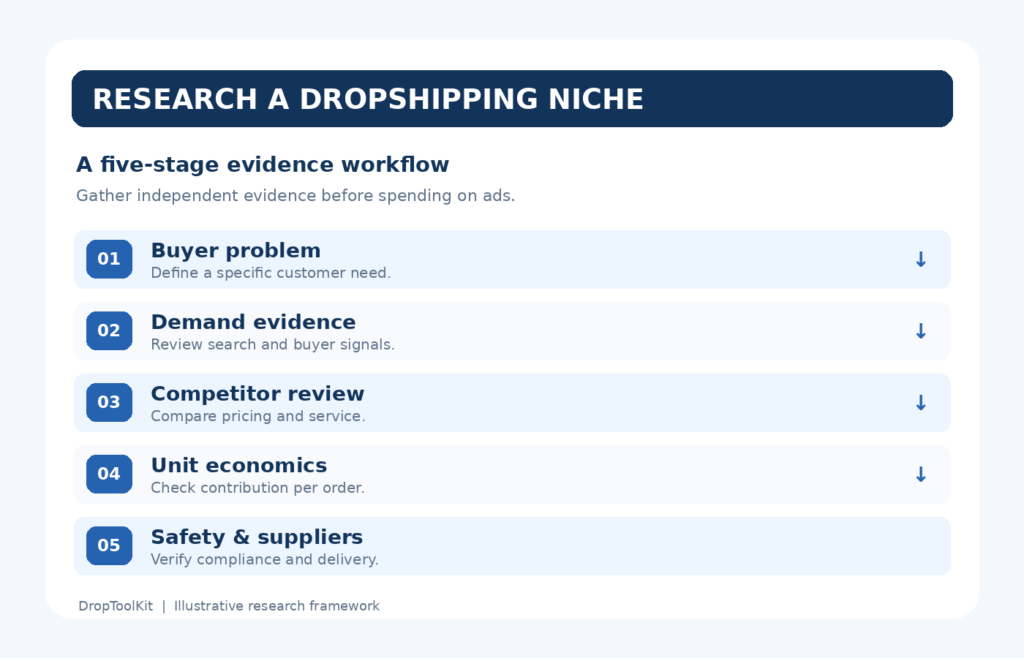
Step 1: Identify buyers and problems, not just products
Start with a customer situation you can describe in one sentence. For example: ‘People working at small desks need practical ways to store everyday accessories without clutter.’ This is more useful than ‘sell office gadgets’, because it identifies a buyer and a specific problem.
Make a shortlist of three candidate niches. For each, record the target buyer, problem, typical order contents, price range, supplier possibilities and the most obvious reason someone would choose your shop.
Prompts to guide your research:
- What is the customer trying to do or avoid?
- Is the need frequent, urgent, seasonal or occasional?
- Can you offer useful compatibility, sizing or material information?
- Are there at least several complementary products with a coherent purpose?
- Would a buyer trust an unfamiliar retailer with this type of purchase?
A niche that requires unverifiable medical, environmental or performance claims is a poor place for an inexperienced seller to improvise. Research the relevant rules before making any such claims.
Step 2: Check demand with more than one signal
Use Google Trends to compare interest over time. Set the geographical location to the United Kingdom if that is your initial customer market, and compare terms within a consistent period. Review both the previous 12 months and a longer window where possible, so that a seasonal peak is not mistaken for sustained growth.
Important: Google Trends values are relative indices, not monthly search volumes or numbers of buyers. Google explains that its data is sampled and normalised to a 0–100 scale. A high reading cannot tell you how many orders you will receive.
Cross-check what you see with:
- Relevant search-result pages and the questions buyers ask.
- Marketplace listings, availability, prices and customer complaints.
- Search-volume estimates from a dedicated keyword research tool, if available.
- Customer communities discussing practical problems rather than simply sharing viral videos.
Record dates, markets, search terms and screenshots or notes in a research sheet. Treat any number reported by a third-party SEO tool as an estimate, not a promise of demand.
How to spot a seasonal niche
Compare at least two annual cycles if the data is available. A niche can still work when its main buying season is short, but your cash flow, delivery lead times and acquisition budget need to reflect that seasonality. A December search spike does not necessarily justify advertising the same product all year.
Step 3: Assess competition and differentiation
Search for three to five real retailers serving the same buyer and check their entire offer: product specifications, final price including delivery, fulfilment promises, customer support, guarantees and the clarity of their returns information.
Do not simply count adverts or assume that a popular category is ‘saturated’. Competitor adverts are evidence that businesses are promoting products, not evidence of profitable campaigns. Likewise, a market with very few adverts may have weak demand rather than an easy opportunity.
Look for genuine ways to help customers choose: reliable dimensions, better compatibility tables, careful comparisons, clear delivery dates, realistic product photography and responsive support. Never present a competitor’s alleged failure as fact without evidence.
Step 4: Calculate contribution per order in pounds
A niche can generate orders and still lose money. Build a conservative per-order estimate before using the word ‘profitable’.
Illustrative example only — not an industry average or supplier quotation:
| Item | Amount |
|---|---|
| Customer selling price | £39.99 |
| Supplier product cost | −£13.00 |
| Shipping and fulfilment | −£4.50 |
| Payment/transaction costs | −£1.50 |
| Allowance for expected returns and support | −£2.00 |
| Allocated other variable costs | −£3.00 |
| Contribution before advertising | £15.99 |
| Advertising cost per acquired order | −£12.00 |
| Illustrative contribution after advertising | £3.99 |
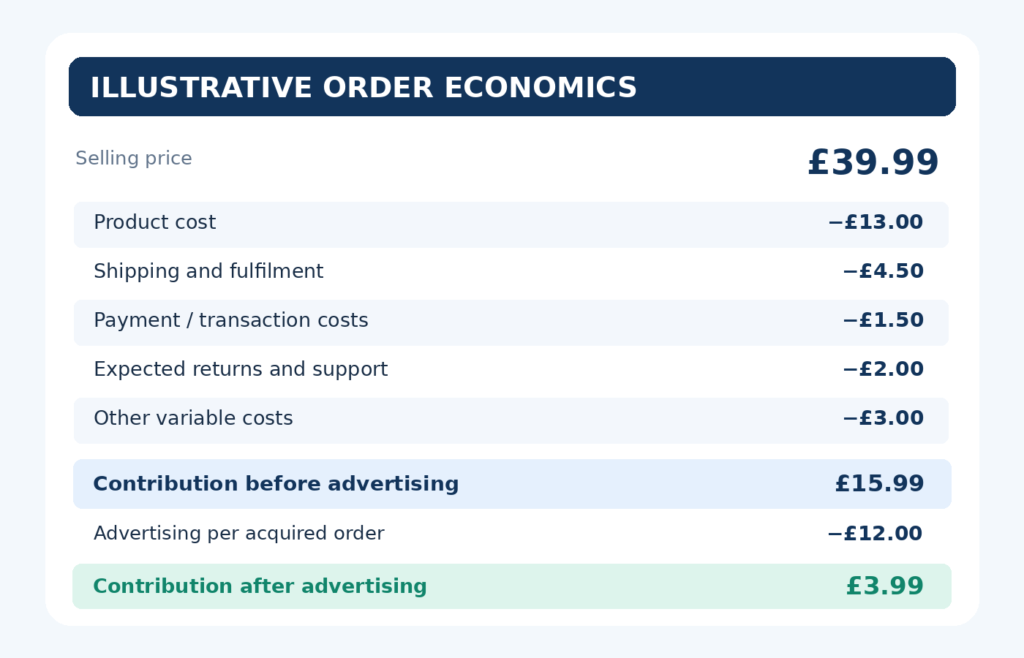
The arithmetic is: £39.99 − £13.00 − £4.50 − £1.50 − £2.00 − £3.00 = £15.99 before advertising, and £15.99 − £12.00 = £3.99 afterwards.
This is not net business profit. It does not necessarily include every overhead, tax, finance charge or exceptional return, and it assumes each estimated cost is allocated correctly. The appropriate VAT treatment depends on the specific transaction and business circumstances; calculate on a consistent VAT basis rather than mixing VAT-inclusive revenue with VAT-exclusive costs.
If acquisition costs rise from £12 to £17, the same order becomes £1.01 negative after advertising. That illustrates why an apparently healthy mark-up cannot, on its own, establish niche profitability.
For a fuller explanation of cost and margin definitions, read dropshipping profit margins. Use the free Profit Calculator to explore your own price and cost assumptions. Confirm how its inputs treat each cost, and separately account for any items the calculator does not model.
Step 5: Verify suppliers and delivery claims
A supplier’s product photograph is not proof of quality or fulfilment reliability. Before listing a product, check the supplier’s legal identity where appropriate, product specifications, traceability information, actual shipping origin, applicable safety documentation, returns process and responsiveness.
For a structured supplier due-diligence approach, see how to find reliable dropshipping suppliers. Order a sample when practical. Inspect materials, packaging, instructions and consistency with the listing. Use a realistic delivery destination for your test; a UK order shipped from a warehouse elsewhere may not resemble the times quoted for domestic delivery.
You can use DropToolKit’s Shipping Time Comparator as an initial comparison aid, but confirm live prices, stock locations, delivery estimates and service availability directly with suppliers before publishing promises to customers. Delivery figures in comparison tools can change and are not contractual guarantees.
UK sellers also need clear pre-contract information on delivery arrangements and costs. Government guidance on online and distance selling explains relevant customer-facing requirements.
Step 6: Screen UK product-safety and consumer-law risks
Do this before deciding that a niche is suitable. The UK Office for Product Safety and Standards explains that businesses making, importing, distributing or selling products must ensure products comply with applicable safety requirements. Different product categories can carry additional rules, and Great Britain and Northern Ireland may have different regimes.
The business should check the applicable regulations, supplier documentation, labels, warnings and traceability. For a first project, categories involving electrical equipment, children’s products, cosmetics, food-related products or health claims may require additional specialist checks. That is not a blanket prohibition; it is a reason to obtain appropriate evidence rather than treating the niche as simple.
Read the government’s product safety advice for businesses and relevant category-specific guidance. Also check the Competition and Markets Authority’s consumer-law guidance for accurate pricing, advertising, reviews and returns information.
If the legal status or safety evidence is unclear, pause that product until it has been checked. A high niche score cannot compensate for non-compliance.
Step 7: Compare three candidate niches consistently
The following is a fictional research exercise. These ratings are hypotheses to investigate, not actual market findings or scores generated by the DropToolKit tool.
| Candidate niche | Potential advantage | Main question to investigate |
|---|---|---|
| Small-desk organisation accessories | A clearly defined space-saving problem | Can suppliers provide consistent sizes, materials and delivery? |
| Non-electrical pet travel accessories | A recognisable use case and potential bundles | Are product durability and safety claims substantiated? |
| Decorative plant display accessories | Visually demonstrable combinations | Are packaging, breakage and seasonality manageable? |
For each candidate, record supporting evidence and rate the eight scorer factors from 1 (poor) to 10 (excellent). On the competition factor, 10 means relatively favourable competition conditions, not high competition. Then enter the values into the Niche Profit Scorer and compare the breakdowns.
A stronger score should lead to the next verification task, not an automatic buying or advertising decision. A candidate with poor safety documentation or unacceptable shipping must be excluded regardless of score.
A practical evidence checklist
| Question | Evidence to collect | Result |
|---|---|---|
| Is demand plausible? | Dated UK search research and buyer questions | Pass / Investigate / Stop |
| Is the offer distinctive? | Three to five competitor comparisons | Pass / Investigate / Stop |
| Can an order contribute enough? | Conservative GBP cost scenario | Pass / Investigate / Stop |
| Can the supplier fulfil reliably? | Sample, dispatch terms, returns and traceability | Pass / Investigate / Stop |
| Is the product suitable to sell? | Applicable safety and consumer-law checks | Pass / Investigate / Stop |
Step 8: Validate cautiously before scaling
Research reduces uncertainty; it does not eliminate it. Once you have a credible shortlist, test product quality, clarity of your offer and genuine customer response before committing heavily to stock, subscriptions or advertising.
Set a maximum affordable testing budget, define what would count as an acceptable result, and record conversion, refunds, delivery performance and contribution after advertising. Do not scale solely because impressions, clicks or a niche score look encouraging.
When you move from assessing a market to testing an individual product, read how to validate a dropshipping product before ads.
Common mistakes when choosing a niche
Copying a ‘top 10 niches’ list without research. Such lists can offer inspiration, not evidence that a niche is profitable for your suppliers, prices and target market.
Confusing gross margin with money available for advertising. Include payment fees, shipping, expected refunds, support and other variable costs before estimating break-even acquisition cost.
Treating Google Trends as a sales forecast. It shows relative search interest, not the number of prospective customers who will purchase.
Ignoring delivery and returns. A low-cost supplier may become an expensive choice when products arrive late or are frequently returned.
Trusting a score without checking assumptions. A subjective score is most useful when each rating is supported by dated, verifiable evidence.
Overlooking compliance. Selling online does not remove product-safety or consumer-law obligations.
Frequently asked questions
What is the most profitable dropshipping niche in 2027?
There is no verified universal winner. Profitability depends on the customer, supplier terms, total cost per order, fulfilment, acquisition costs and the seller’s ability to compete. Use current evidence for your specific market rather than relying on predictions about 2027.
Are low-competition dropshipping niches always better?
No. Few competitors can mean limited demand. A competitive niche may still be workable if you have a distinctive, verifiable offer and viable unit economics.
How can I research a niche for free?
Start with Google Trends, search results, marketplace comparisons, customer feedback and a documented cost model. Then use DropToolKit’s free Niche Profit Scorer to organise your eight-factor assessment. Free research will not reveal every competitor’s conversion rate or margin.
What score on the Niche Profit Scorer guarantees profit?
None. The score reflects the values entered by the user. Use the breakdown to locate assumptions requiring evidence; do not treat a score threshold as a guarantee of sales or net profit.
Should a beginner start with a broad or narrow niche?
A focused audience and problem are often easier to explain and research than a general shop, but an excessively narrow market can limit demand. Look for a specific need with a credible range of related products.
Do UK dropshippers have product-safety responsibilities?
Yes. The applicable duties depend on the product, the seller’s role in the supply chain and where the goods are supplied. Consult official UK product-safety guidance and seek specialist advice when necessary.
Next step: score a niche, then verify the evidence
Choose three candidate niches and research each one using the same checklist. Enter your ratings into the free DropToolKit Niche Profit Scorer, compare the weaknesses, and investigate supplier, safety, shipping and per-order cost evidence before making a commitment.
A good niche decision is not a prediction. It is a documented choice made with realistic assumptions and clear reasons to continue, investigate or stop.
Sources and further reading
- Google Trends Help — FAQ about Google Trends data
- Google Trends Help — Compare search terms
- GOV.UK — Product safety advice for businesses
- GOV.UK — Online and distance selling
- GOV.UK / CMA — Selling goods and services: complying with consumer law
- Shopify — Dropshipping Niches: 8 Profitable Ideas for 2026
- Printful — 10 Profitable Dropshipping Niches in 2026